
Have you ever wondered why your doctor might switch you from a pricey brand-name pill to a cheaper generic one? It’s not just about saving money. It’s about science. Specifically, it comes down to two big words that sound complicated but are actually quite simple: bioavailability and bioequivalence. These concepts are the backbone of modern pharmacy regulation. They ensure that when you pop a generic version of a medication, it works in your body exactly like the original brand-name drug.
If you’ve ever felt skeptical about switching pills, you’re not alone. But understanding how these terms work can give you peace of mind. Let’s break down what they mean, how they are measured, and why they matter for your health wallet and your well-being.
What Is Bioavailability?
Think of Bioavailability as the measure of how much medicine actually gets into your bloodstream after you take it. When you swallow a pill, not all of it makes it to where it needs to go. Some of it might get stuck in your stomach, some might be broken down by your liver before it even reaches your heart or brain, and some might just pass right through you.
The U.S. Food and Drug Administration (FDA) defines bioavailability as "the rate and extent to which an active ingredient is absorbed from a drug product and becomes available at the site of action." In plain English, it answers the question: "How much of this drug is my body actually using?"
There are two main ways to look at this:
- Absolute Bioavailability: This compares a drug taken orally (by mouth) to the same drug injected directly into a vein (intravenous). An IV injection has 100% bioavailability because it goes straight into the blood. If you take a pill and only 50% of it reaches your bloodstream compared to the IV shot, its absolute bioavailability is 50%.
- Relative Bioavailability: This compares two different forms of the same drug. For example, does a liquid syrup absorb faster or better than a tablet? Or does a new generic formula work as well as the old brand-name formula?
Several factors affect bioavailability. Your digestive system plays a huge role. If a drug isn’t fully absorbed in the gut, or if your liver metabolizes it quickly (known as first-pass metabolism), the bioavailability drops. For instance, a hypothetical drug might have 70% absorption in the gut, but then lose another 20% to liver processing, resulting in a final bioavailability of around 50%.
What Is Bioequivalence?
Now, let’s talk about Bioequivalence. While bioavailability looks at a single drug, bioequivalence is a head-to-head comparison. It asks: "Are Product A and Product B the same in how they deliver the drug to your body?"
This concept is crucial for Generic Drugs. Before a generic drug can hit the shelves, the manufacturer must prove it is bioequivalent to the Reference Listed Drug (RLD), which is usually the original brand-name drug.
The FDA defines bioequivalence as "the absence of a significant difference in the rate and extent to which the active ingredient... becomes available at the site of drug action." Basically, if the generic delivers the same amount of medicine, at the same speed, as the brand name, they are considered bioequivalent.
Why does this matter? Because if two drugs are bioequivalent, they should have the same therapeutic effect and safety profile. You shouldn’t feel a difference in how well they work or how many side effects you experience.
The Science Behind the Comparison: AUC and Cmax
How do regulators actually prove bioequivalence? They don’t just guess. They run strict clinical trials involving healthy volunteers. Scientists measure blood levels of the drug over time and look at two key numbers:
- AUC (Area Under the Curve): Imagine a graph showing drug concentration in your blood over time. The area under that curve represents the total exposure to the drug. If the generic has a similar AUC to the brand name, it means your body received the same total amount of medicine.
- Cmax (Maximum Concentration): This is the peak level of the drug in your blood. If the generic reaches a similar peak height as the brand name, it means the drug hits your system with similar intensity.
Scientists also look at Tmax, which is the time it takes to reach that peak. However, Tmax is less strictly regulated because small differences in timing rarely change how well the drug works.
| Parameter | Full Name | What It Measures | Role in Approval |
|---|---|---|---|
| AUC | Area Under the Curve | Total drug exposure over time | Critical; must match within statistical limits |
| Cmax | Maximum Concentration | Peak drug level in blood | Critical; ensures similar intensity |
| Tmax | Time to Maximum Concentration | Speed of absorption | Informative; minor differences allowed |
The 80-125 Rule: Why Generics Are Safe
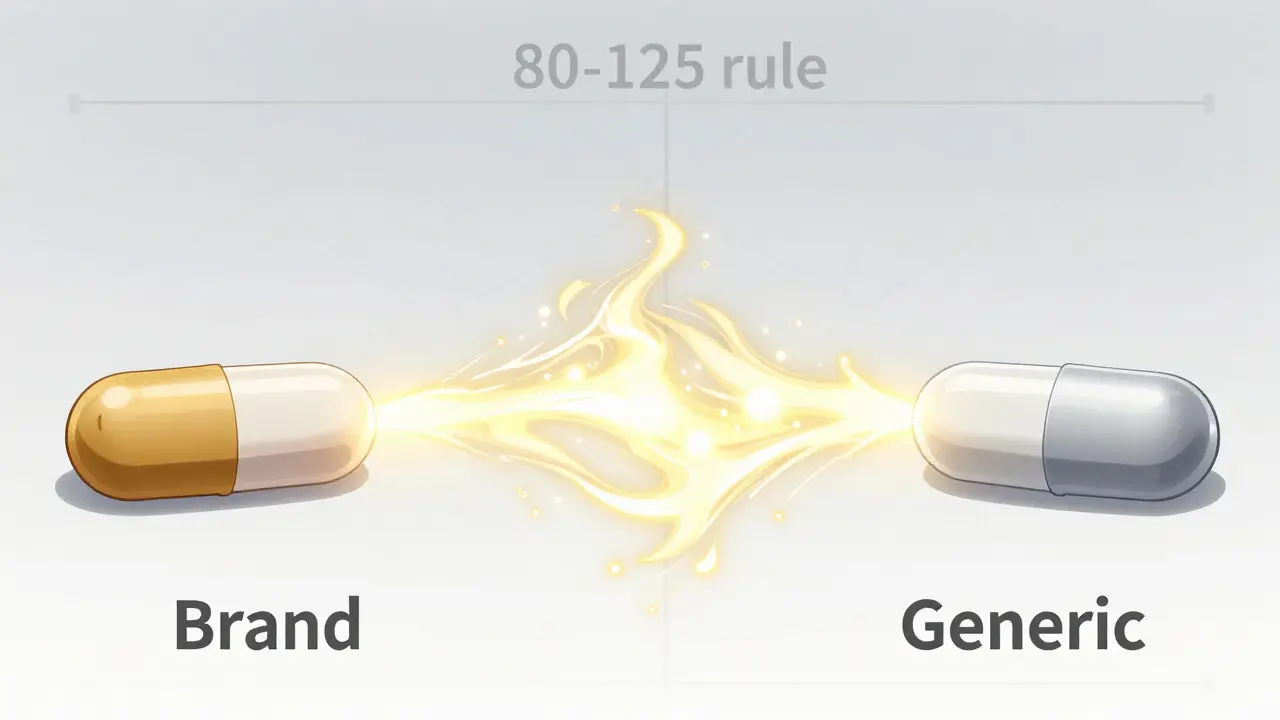
You might think that for a generic to be approved, it has to be identical to the brand name-down to the last molecule. But biology isn’t that precise. People vary, and manufacturing processes have tiny fluctuations. So, regulators use a statistical range called the 80-125 rule.
Here’s how it works: The geometric mean ratio of the generic’s AUC and Cmax compared to the brand name must fall between 80% and 125%. More specifically, the 90% confidence interval of this ratio must stay within that window. This doesn’t mean the generic can be 20% weaker or stronger. It means that statistically, there is no significant difference between the two products.
Dr. Robert Lionberger of the FDA has stated that this approach "balances patient safety with generic drug access." It’s a scientifically sound method that has been used for decades. In fact, data shows that 99.7% of generic drugs approved between 2010 and 2020 met these criteria without any significant therapeutic differences from their brand-name counterparts.
Exceptions: Narrow Therapeutic Index Drugs
While the 80-125 rule works for most medications, some drugs are trickier. These are known as Narrow Therapeutic Index (NTI) Drugs. These are medications where a small change in dose can lead to serious side effects or lack of efficacy. Examples include warfarin (a blood thinner), levothyroxine (for thyroid issues), and certain anti-seizure medications.
For NTI drugs, the FDA applies tighter standards. Instead of 80-125%, the acceptance range might be narrowed to 90-111% or 90-112%. This ensures that even minute differences in absorption don’t compromise patient safety. Dr. Lawrence Lesko, a pharmacology expert, has argued for these stricter limits, noting that "narrow therapeutic index drugs require tighter bioequivalence limits" to prevent adverse outcomes.
If you are taking an NTI drug, it’s worth discussing with your pharmacist whether sticking to one manufacturer is advisable, even if generics are approved. Some patients report subtle differences, though studies suggest these are often due to adherence issues or placebo effects rather than true bioequivalence failures.

Real-World Evidence: Do Generics Work?
Let’s look at what happens outside the lab. Real-world data supports the efficacy of bioequivalence standards. A study documented by Dr. Sarah Chen on the American Pharmacists Association forums followed 1,247 patients switched from brand to generic antihypertensives. Only 17 patients (1.36%) reported issues, and after investigation, only 4 cases (0.32%) were confirmed as true therapeutic inequivalence. The rest were linked to other factors like missed doses or unrelated health changes.
Patient advocacy groups echo this. A 2022 survey by Patients for Better Drugs found that 87.4% of respondents experienced no difference when switching to generics. While 12.6% reported issues, only 3.8% of those cases were medically confirmed as related to bioequivalence differences. The majority were attributed to psychological factors or other medical variables.
However, anecdotes exist. Online forums like Reddit occasionally feature users complaining about generic levothyroxine. While these experiences are valid to the individuals, they represent a tiny fraction of the population. Regulatory agencies monitor these reports closely, and if a pattern emerges, they can tighten standards or recall specific batches.
Challenges and Future Trends
Bioequivalence testing isn’t always straightforward. Complex drugs, such as topical creams, inhalers, or extended-release formulations, pose challenges. For these, traditional blood tests (AUC/Cmax) might not reflect how the drug works locally in the tissue. For example, a cream might have low systemic absorption but high local effect. In these cases, regulators may use alternative methods like in vitro dissolution testing or physiologically-based pharmacokinetic (PBPK) modeling.
The global market for bioequivalence testing was valued at $2.84 billion in 2022 and is growing. As more patents expire, more generics enter the market, driving demand for rigorous testing. The FDA and European Medicines Agency (EMA) continue to update guidelines to handle these complex products. By 2027, analysts predict that 30% of bioequivalence assessments for complex generics will incorporate advanced PBPK modeling to supplement traditional methods.
Practical Tips for Patients
So, what should you do with this information? Here are a few practical steps:
- Trust the Process: For most common medications (like antibiotics, pain relievers, or cholesterol drugs), generics are safe and effective equivalents to brand names.
- Check for NTI Drugs: If you take thyroid medication, blood thinners, or anti-seizure drugs, ask your pharmacist if you should stick to one manufacturer. Consistency can help minimize variability.
- Monitor Your Response: When switching from brand to generic, pay attention to how you feel. Note any changes in symptom control or side effects. Report these to your doctor, but remember that individual variation exists.
- Don’t Confuse Inactive Ingredients: Bioequivalence only guarantees the active ingredient behaves the same. Generics may have different fillers, dyes, or binders. If you have allergies to certain dyes or gluten, check the inactive ingredients list.
Is bioavailability the same as bioequivalence?
No. Bioavailability measures how much of a single drug enters your bloodstream. Bioequivalence compares two different products (usually a generic and a brand name) to see if they deliver the drug at the same rate and extent. Bioequivalence relies on bioavailability measurements but adds a statistical comparison framework.
Why do generics cost less than brand names?
Brand-name companies spend billions on research, development, and clinical trials to create new drugs. Generic manufacturers don’t need to repeat these expensive studies; they only need to prove bioequivalence. This lower cost allows them to sell the drug at a significantly reduced price.
Can I switch between different generic manufacturers?
Generally, yes. All approved generics must meet the same bioequivalence standards as the brand name. However, for narrow therapeutic index drugs, some doctors recommend sticking to one manufacturer to avoid minor variations in inactive ingredients or absorption rates.
What is the 80-125 rule?
The 80-125 rule is the statistical standard used by the FDA to determine bioequivalence. It requires that the 90% confidence interval of the ratio of geometric means for AUC and Cmax falls between 80% and 125%. This ensures no significant difference in drug exposure between the test and reference products.
Do generics have the same side effects as brand names?
Yes, regarding the active ingredient. Since the active ingredient is delivered in the same way, the side effect profile should be identical. However, rare allergic reactions to inactive ingredients (like dyes or fillers) in generics might differ from brand names.


Wendy Engelmann
June 6, 2026 AT 21:39