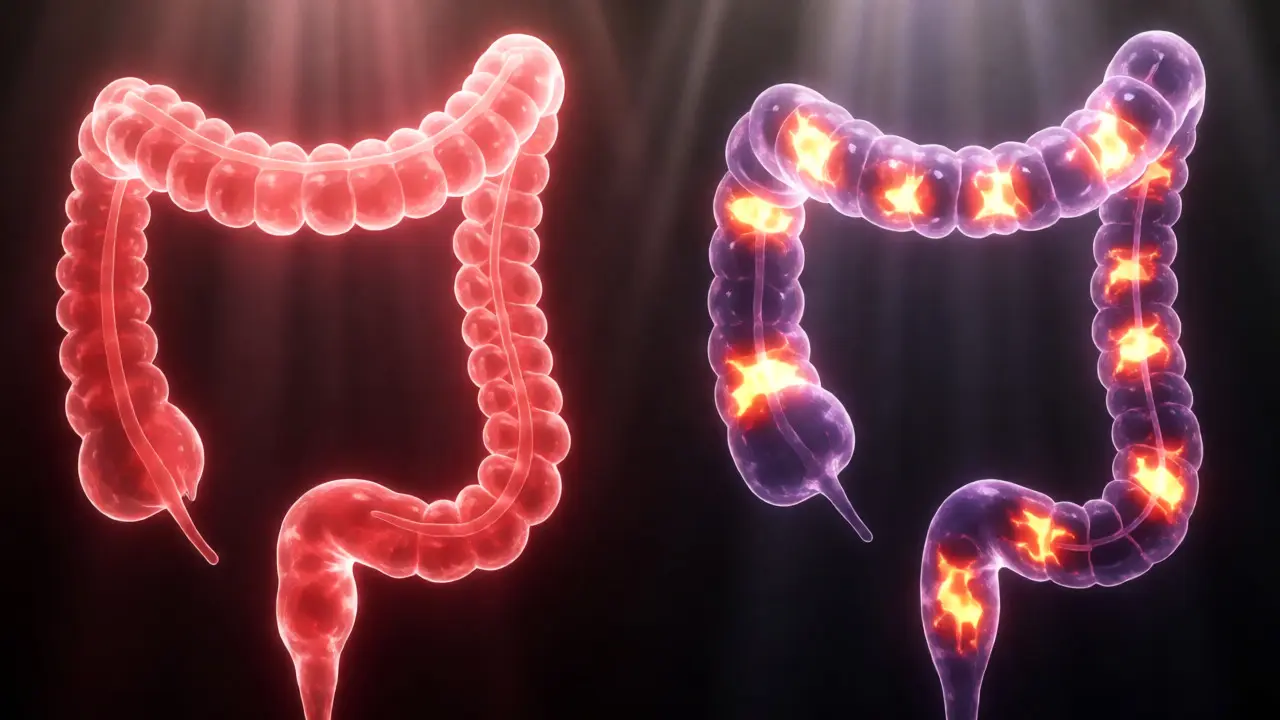
Imagine your immune system decides to attack your own gut. Not just a little irritation, but a full-blown siege. This is the reality for millions living with Inflammatory Bowel Disease (IBD), a group of chronic conditions characterized by inappropriate immune responses leading to gastrointestinal inflammation. But here is the tricky part: IBD isn't one single thing. It’s mostly split into two distinct rivals-Crohn’s disease and Ulcerative Colitis (UC). While they share similar symptoms like pain and fatigue, their behavior inside your body is wildly different. Confusing them can lead to the wrong treatment path. So, how do you tell them apart? And why does it matter?
The Anatomy of the Attack
The biggest difference between these two conditions lies in where they strike. Think of your digestive tract as a long tube running from mouth to anus. In Ulcerative Colitis, inflammation is confined exclusively to the colon and rectum, starting at the rectum and spreading continuously upward. It’s predictable. If you have UC, the damage is always continuous and limited to the large intestine.
Crohn’s disease, on the other hand, can affect any part of the gastrointestinal tract from mouth to anus, though it most commonly targets the end of the small intestine and the beginning of the colon. It doesn’t play by the rules of continuity. Crohn’s creates "skip lesions," meaning you might have a patch of inflamed tissue, followed by healthy tissue, followed by more inflammation. This erratic pattern makes diagnosis harder and management more complex.
| Feature | Ulcerative Colitis | Crohn’s Disease |
|---|---|---|
| Affected Area | Colon and Rectum only | Mouth to Anus (anywhere) |
| Inflammation Pattern | Continuous, starting from rectum | Discontinuous (Skip Lesions) |
| Depth of Damage | Inner lining (Mucosa/Submucosa) | All layers (Transmural) |
How Deep Does It Go?
This is where things get physically serious. Ulcerative Colitis stays superficial. It attacks the innermost lining of the bowel wall-the mucosa. Because it doesn’t dig deeper, the structural integrity of the bowel usually remains intact, even during severe flares.
Crohn’s Disease is a deep diver. It causes transmural inflammation, meaning it penetrates through all layers of the bowel wall, including the muscle and outer serosa. Why does this matter? Because when the whole wall is inflamed, it can crack. These cracks can tunnel through the tissue, creating abnormal connections called fistulas. You might find yourself dealing with abscesses or strictures (narrowing of the intestine) that block food passage. These complications are rare in UC but occur in about 33% of Crohn’s patients over their lifetime.
Spotting the Symptoms
Both diseases cause abdominal pain, diarrhea, weight loss, and fatigue. If you’re sitting on the toilet wondering which one you have, the specific nature of your symptoms might give a clue.
- Bleeding: Rectal bleeding is a hallmark of UC, occurring in up to 75% of cases. In Crohn’s, bleeding happens less frequently (around 35%) unless the colon is heavily involved.
- Urgency: People with UC often report a sudden, urgent need to use the bathroom because the rectum is directly affected. Crohn’s patients may experience urgency too, but it’s less defining.
- Nutrition Issues: Since Crohn’s often affects the small intestine, where nutrients are absorbed, malnutrition and vitamin deficiencies (like B12 or Iron) are much more common than in UC.
It’s also worth noting that stress plays a role. Patient communities suggest that while stress triggers flares in both, dietary triggers like dairy or high-fiber foods are reported more frequently by those with Crohn’s, likely due to the mechanical issues caused by strictures.

Diagnosis: Putting the Puzzle Together
There is no single blood test that says "You have Crohn’s" or "You have UC." Diagnosis is a detective game. Doctors rely on a combination of tools.
A Colonoscopy with biopsy is the gold standard. For UC, doctors look for continuous redness and pseudopolyps starting from the rectum. For Crohn’s, they hunt for skip lesions, cobblestone-like textures, and ulcers that go deep into the tissue.
Imaging helps fill in the gaps. If a colonoscopy looks normal but symptoms persist, doctors might use an MRI enterography or a capsule endoscopy (a pill-sized camera) to check the small intestine, which is invisible to a standard colonoscope. Blood markers help too. A positive pANCA test points toward UC (60-70% accuracy), while ASCA antibodies are more common in Crohn’s. However, roughly 10-15% of cases remain classified as "Indeterminate Colitis" because the features overlap so much.
Treatment Strategies: Topical vs. Systemic
Because the diseases behave differently, we treat them differently.
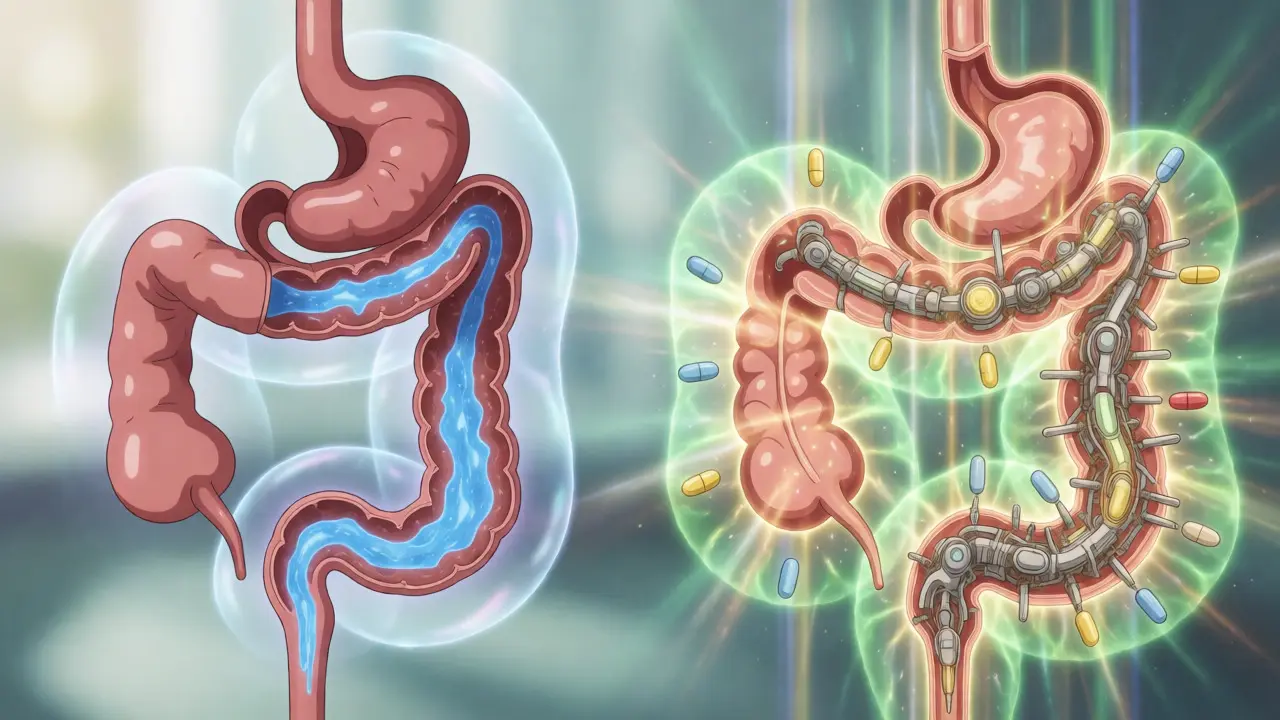
For mild-to-moderate Ulcerative Colitis, since the inflammation is limited to the colon surface, topical treatments work wonders. Enemas and suppositories deliver medication like 5-aminosalicylates (5-ASAs) directly to the site. This approach achieves remission in 60-80% of cases without exposing the whole body to heavy drugs.
Crohn’s requires a systemic approach. Because it can be anywhere and goes deep, pills and injections are necessary. Immunosuppressants like azathioprine or biologics like infliximab target the immune system globally. Biologics are powerful; anti-TNF agents achieve clinical remission in 30-40% of Crohn’s patients. However, they come with higher costs and potential side effects compared to the localized care often used for UC.
Surgery: Cure or Management?
This is perhaps the most critical distinction for long-term planning.
If you have severe Ulcerative Colitis, surgery can actually cure the disease. Removing the entire colon and rectum (proctocolectomy) eliminates the source of inflammation. About 10-15% of UC patients undergo this procedure within ten years. Once the colon is gone, the disease is gone.
For Crohn’s Disease, surgery is not a cure. Surgeons remove the damaged segment, but the disease can return elsewhere in the GI tract. Data shows that 50% of Crohn’s patients require repeat surgery within ten years because the inflammation recurs at the surgical site. Therefore, surgery in Crohn’s is viewed as a tool to manage complications (like strictures) rather than a final solution.
Living with the Difference
Knowing which type you have changes your daily life. UC patients often deal with frequent bathroom trips and anxiety about accidents. Crohn’s patients might struggle more with energy levels due to nutrient absorption issues and face unpredictable blockages.
Both groups face extra-intestinal manifestations-symptoms outside the gut. Joint pain, skin rashes like erythema nodosum, and eye inflammation affect 25-40% of IBD patients regardless of type. Interestingly, primary sclerosing cholangitis, a liver condition, is strongly linked to UC (affecting 3-7% of patients) but is rare in Crohn’s.
Emerging therapies offer hope. Fecal Microbiota Transplantation (FMT) has shown better results in UC (32% remission) than in Crohn’s (22%), highlighting once again that these are distinct biological entities. New drugs targeting specific pathways are entering trials, promising more tailored approaches for each subtype.
Ultimately, distinguishing between Crohn’s and UC isn’t just academic-it dictates your medical roadmap. Whether you’re managing a superficial colon issue or a deep, systemic intestinal battle, understanding the enemy is the first step to winning the war.
Can you have both Crohn’s disease and ulcerative colitis?
No, you cannot have both simultaneously. They are mutually exclusive diagnoses. However, some patients initially diagnosed with one may be reclassified to the other later if new symptoms appear. About 12% of initial UC diagnoses are later changed to Crohn’s disease after further observation.
Which is worse, Crohn’s or Ulcerative Colitis?
Neither is universally "worse." Crohn’s is often considered more complex due to its potential to affect any part of the GI tract and cause strictures or fistulas. UC is generally more predictable and curable via surgery. Severity depends entirely on the individual case.
Does diet affect Crohn’s and UC differently?
Yes. While there is no universal IBD diet, Crohn’s patients often report specific food triggers like dairy or high-fiber items causing blockages or pain. UC patients may find that low-residue diets help during flares, but dietary triggers are less consistently reported than in Crohn’s.
Is surgery a cure for both diseases?
Surgery is a cure for Ulcerative Colitis if the entire colon and rectum are removed. For Crohn’s disease, surgery removes damaged sections but is not a cure, as the disease can recur in remaining parts of the digestive tract.
What tests distinguish Crohn’s from UC?
Doctors use colonoscopy with biopsies, MRI enterography, and blood tests (pANCA and ASCA). Continuous inflammation suggests UC, while skip lesions and transmural damage indicate Crohn’s. No single test is definitive; diagnosis requires integrating multiple findings.