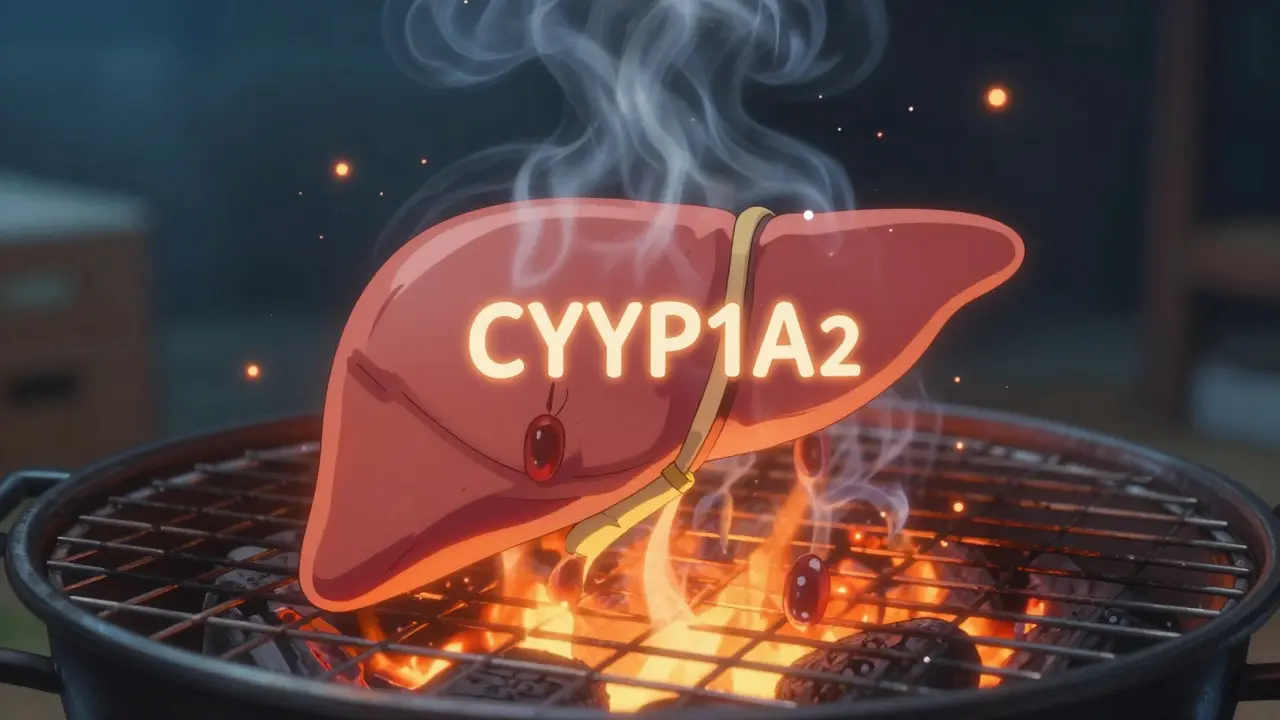
CYP1A2 Impact Estimator
How charcoal-grilled meat affects your medications
This tool estimates the relative impact of charcoal-grilled meat consumption on CYP1A2 enzyme activity compared to smoking. Based on current scientific evidence, the effect from grilled meat is generally minimal compared to smoking.
Estimated CYP1A2 Activity Change
Practical Advice
What happens when your grilled steak meets your medication?
Think about your favorite barbecue meal. A juicy steak, chicken, or burger cooked over charcoal. Now consider this: that delicious char might interact with your prescription drugs. It’s not just a myth-it’s a real pharmacology topic involving the CYP1A2 a liver enzyme responsible for breaking down about 10% of commonly used medications, including clozapine, theophylline, and caffeine. This enzyme’s activity can change based on what you eat, and charcoal-grilled meats are one factor scientists have studied. But how big of a deal is it? Let’s break it down.
How charcoal-grilled meats affect your body
When meat is cooked at high temperatures over charcoal, it creates polycyclic aromatic hydrocarbons (PAHs) chemicals formed when fat drips onto hot coals and creates smoke that settles on the meat and heterocyclic amines (HCAs) compounds formed from amino acids and creatine in meat during high-heat cooking. These substances trigger a biological pathway called the aryl hydrocarbon receptor (AhR) a protein in cells that activates when exposed to PAHs, leading to increased production of CYP1A2. Think of AhR as a switch: when PAHs from grilled meat bind to it, the switch turns on CYP1A2 production. More CYP1A2 means your body processes certain medications faster.
The two landmark studies that changed the conversation
Scientists have looked at this issue closely. Two major studies from 1999 and 2005 gave conflicting results, which is why there’s still debate today. Here’s how they compare:
| Study | Participants | Method | Key Findings | Limitations |
|---|---|---|---|---|
| Fontana et al. (1999) | 10 healthy adults (5 male, 5 female), ages 22-45 | 7 days of chargrilled meat diet; measured via duodenal biopsies | 47% increase in hepatic CYP1A2 activity; 53% rise in intestinal CYP1A1 protein | Small sample size; limited demographic |
| Larsen et al. (2005) | 24 non-smoking males, ages 19-35 | 5 days of charcoal-broiled meat; caffeine metabolic ratio testing | No statistically significant change in CYP1A2 activity | Short duration; no female participants; indirect measurement |
Fontana’s study used direct tissue measurements and saw clear enzyme increases. Larsen’s study used functional tests like caffeine metabolism and found no real change. Why the difference? Fontana measured the enzyme itself in tissues, while Larsen measured how the enzyme worked in real-time using drug probes. The methods matter. Also, Fontana’s study lasted longer (7 days vs. 5 days) and included both men and women. Larsen’s group was only men, which might have affected results since hormones influence enzyme activity.

What do experts say today?
Doctors and pharmacists don’t usually worry about grilled meat and medications. Why? Because the evidence isn’t strong enough to change real-world practice. The FDA the U.S. Food and Drug Administration, which regulates medications and food safety and EMA the European Medicines Agency, the EU’s equivalent regulatory body have no warnings about grilled meat interactions in drug labels. The Clinical Pharmacogenetics Implementation Consortium (CPIC) a group that creates guidelines for using genetic information in drug treatment says dietary factors like grilled meat aren’t significant for CYP1A2 substrates. Dr. Lance R. Pohle-Krauza, editor of Drug Metabolism and Disposition, put it bluntly: "While academically interesting, the clinical impact of grilled meat on drug metabolism is negligible compared to other factors like smoking."
Smoking is a much bigger deal. Cigarette smoke increases CYP1A2 activity by 200-400%. If you smoke, that’s far more impactful than any grilled meal. A 2021 survey found only 7% of pharmacists counsel patients about grilled meat interactions-compared to 92% who warn about grapefruit juice. No documented cases of medication toxicity from grilled meat exist in 20 years of clinical practice.
Practical advice for patients
Here’s what you should know if you take medications affected by CYP1A2:
- Clozapine (for schizophrenia): No evidence of grilled meat causing toxicity. Focus on quitting smoking if you smoke-smoking cuts clozapine levels by 30-50%.
- Theophylline (for asthma): Grilled meat won’t noticeably affect it. But smoking or drinking coffee can change theophylline levels significantly.
- Caffeine: Your morning coffee might taste stronger after a charcoal dinner, but the effect is temporary and minor. You’d need to eat grilled meat daily for weeks to see a difference.
Don’t stop grilling. Enjoy your barbecue, but don’t stress about medication interactions. If you take a medication like clozapine, theophylline, or tacrine, talk to your doctor about your diet. They’ll focus on bigger risks like smoking or grapefruit juice. The real takeaway? Smoking has a far greater impact on CYP1A2 than any grilled meal. Quitting smoking is the most important step for anyone on these medications.
Does eating grilled meat really affect my medication?
For most people, the effect is minimal. Studies show inconsistent results, and no cases of medication toxicity directly caused by grilled meat exist. Doctors don’t routinely advise patients to avoid grilled foods. The bigger concern is smoking, which can drastically change how your body processes medications. If you take clozapine, theophylline, or similar drugs, discuss your diet with your pharmacist or doctor, but don’t panic about occasional barbecues.
Which medications are most affected by CYP1A2 changes?
Medications that rely on CYP1A2 for metabolism include clozapine (antipsychotic), theophylline (asthma drug), caffeine (stimulant), and tacrine (Alzheimer’s medication). However, only clozapine and theophylline have narrow therapeutic ranges where changes matter most. Even then, dietary factors like grilled meat rarely cause issues. Smoking, caffeine intake, and certain medications (like fluvoxamine) have much larger effects.
How does smoking compare to grilled meat for CYP1A2 effects?
Smoking is 10-20 times more impactful. Cigarette smoke increases CYP1A2 activity by 200-400%, while charcoal-grilled meat might cause a 5-50% increase at most-depending on the study. For example, a smoker taking clozapine may need double the dose compared to a non-smoker. Grilled meat alone won’t change your medication dose. Quitting smoking is the single most effective way to stabilize CYP1A2-related drug metabolism.
Should I avoid charcoal-grilled foods if I take medication?
No. There’s no evidence that occasional grilled meals interfere with medication safety. The FDA and EMA don’t list grilled meat as a risk. Focus on bigger dietary risks like grapefruit juice (which affects many medications) or excessive caffeine. If you eat grilled meat daily for weeks, you *might* see minor changes, but this is rare. For most people, the benefits of enjoying grilled food outweigh theoretical risks.
What about other cooking methods like baking or boiling?
Baking, boiling, or stewing meat at lower temperatures produces far fewer PAHs and HCAs. Charcoal grilling and charring are the main culprits. If you’re concerned, try marinating meat before grilling (it reduces HCA formation by up to 90%) or using indirect heat. But even then, the effect on medications is negligible compared to smoking or other factors. Cooking method matters more for cancer risk than drug interactions.


Brendan Ferguson
February 5, 2026 AT 21:17