
Imagine trying to put your hands in your pockets, only to find your fingers stubbornly curling toward your palm. You can’t flatten your hand on a table. You struggle to shake someone’s hand or grip a coffee mug firmly. This isn’t just stiffness from sleeping wrong; it is likely Dupuytren’s contracture, a progressive condition where the tissue beneath your palm thickens and tightens, pulling your fingers into a bent position. First described by French surgeon Baron Guillaume Dupuytren in 1831, this disorder affects millions of people, particularly those with Northern European ancestry. While there is no cure, understanding your options-from watchful waiting to advanced surgical techniques-can help you maintain hand function and quality of life.
What Is Dupuytren’s Contracture?
To understand why your hand looks and feels this way, you need to look at the anatomy. Beneath the skin of your palm lies a layer of connective tissue called the palmar fascia, the fibrous tissue that provides structural support to the hand. In a healthy hand, this fascia is flexible. In Dupuytren’s, however, abnormal cells called myofibroblasts proliferate, creating excessive collagen (specifically types I and III). This forms hard nodules and rope-like cords that measure between 2mm and 8mm in thickness.
As these cords shorten, they exert significant force-often exceeding 10 Newtons-pulling your fingers into flexion. The ring finger and little finger are the most commonly affected, accounting for over 50% of cases each according to the American Society for Surgery of the Hand. The progression typically happens in stages:
- Stage 1: Painless nodules form near the base of the ring or little finger.
- Stage 2: Cords develop, extending from the palm into the fingers.
- Stage 3: Visible contracture occurs, usually between 10 and 30 degrees.
- Stage 4: Severe contracture (>45 degrees) causes significant functional impairment.
This process is slow, often taking 5 to 15 years, though some patients experience rapid worsening within two years. Genetic factors play a huge role here. Genome-wide studies have identified susceptibility loci on chromosomes 16q and 20q. If you have a first-degree relative with the condition, your lifetime risk jumps to 68%, compared to just 8% in the general population.
When Should You Seek Treatment?
Not every nodule requires immediate action. Many experts advocate for a "watchful waiting" approach if your hand function remains intact. Dr. Kevin Chung of Michigan Medicine notes that 40% of patients with less than 30 degrees of contracture never progress to severe impairment over ten years. However, intervention becomes necessary when daily life is disrupted.
Clinicians use specific thresholds to determine readiness for treatment. Generally, surgery or other interventions are recommended if you have:
- A metacarpophalangeal (MCP) joint contracture of 30 degrees or more.
- A proximal interphalangeal (PIP) joint contracture of 20 degrees or more.
- Inability to place your palm flat on a surface (a positive "tabletop test").
If you can no longer perform tasks like washing yourself, shaking hands, or gripping tools, it is time to consult a hand specialist. Early intervention doesn't always mean better outcomes; in fact, aggressive early treatment can sometimes lead to unnecessary complications without proven long-term benefits.

Treatment Options: A Detailed Comparison
There is no one-size-fits-all solution. Your choice depends on the severity of the contracture, your age, occupation, and personal preferences. Here is how the main treatments stack up against each other.
| Treatment Method | Success Rate | Recurrence Risk | Recovery Time | Approximate Cost |
|---|---|---|---|---|
| Collagenase Injection (Xiaflex) | 65-78% | Moderate | 1-2 weeks | $3,500 - $5,000 |
| Needle Aponeurotomy | 80-90% | High (30-50% in 3 years) | Days | $1,500 - $3,000 |
| Open Fasciectomy | 90-95% | Low-Moderate (20-30% in 5 years) | 6-12 weeks | $8,000 - $15,000 |
| Limited Fasciectomy with Dermofasciectomy | High | Lowest (10-15% in 5 years) | 3-6 months | $10,000+ |
Collagenase Clostridium Histolyticum (Xiaflex)
This non-surgical option involves injecting an enzyme directly into the cord to break down the collagen bonds. FDA-approved in 2013, it offers a quick fix with minimal downtime. The procedure takes about 15 minutes. However, success hinges heavily on patient compliance. You must begin stretching exercises 24 hours after the injection. Studies show that 92% adherence correlates with an 85% success rate, while poor adherence drops success to 65%. Side effects include bruising, swelling, and intense pain during the straightening process.
Needle Aponeurotomy
Developed by Dr. Jean-Luc Lermusiaux, this minimally invasive technique uses a needle to puncture and release the tight cords. It is ideal for older patients or those who cannot undergo major surgery. The benefit is immediate correction and low cost. The downside? High recurrence rates. Up to 50% of patients may see the contracture return within three years. It is often used as a temporary measure or for early-stage disease.
Open Fasciectomy
This traditional surgical approach involves making an incision to remove the diseased fascia entirely. It provides the most durable results with the lowest recurrence rates among standard procedures. However, it is invasive. Recovery takes 6 to 12 weeks, and complication rates range from 15% to 25%, including risks of nerve injury (3-5%) and complex regional pain syndrome. For severe cases involving multiple fingers, this remains the gold standard.
Emerging Therapies
The field is evolving rapidly. Gene therapy targeting TGF-β1 is currently in Phase I trials, showing promise in reducing cord thickness. Additionally, ultrasound-guided percutaneous devices like the "Fasciotome" are reducing procedure times significantly. Stem cell therapies using adipose-derived cells are also entering late-stage trials, aiming to reduce recurrence by modulating the body’s healing response.
Living with Dupuytren’s: Practical Tips
Whether you choose treatment or monitoring, lifestyle adjustments can help manage symptoms. Avoid repetitive gripping activities that may aggravate the fascia. If you smoke, quitting is crucial-smoking is strongly linked to worse outcomes and higher recurrence rates. Maintain good blood sugar control if you have diabetes, as high glucose levels can exacerbate fibroproliferative disorders.
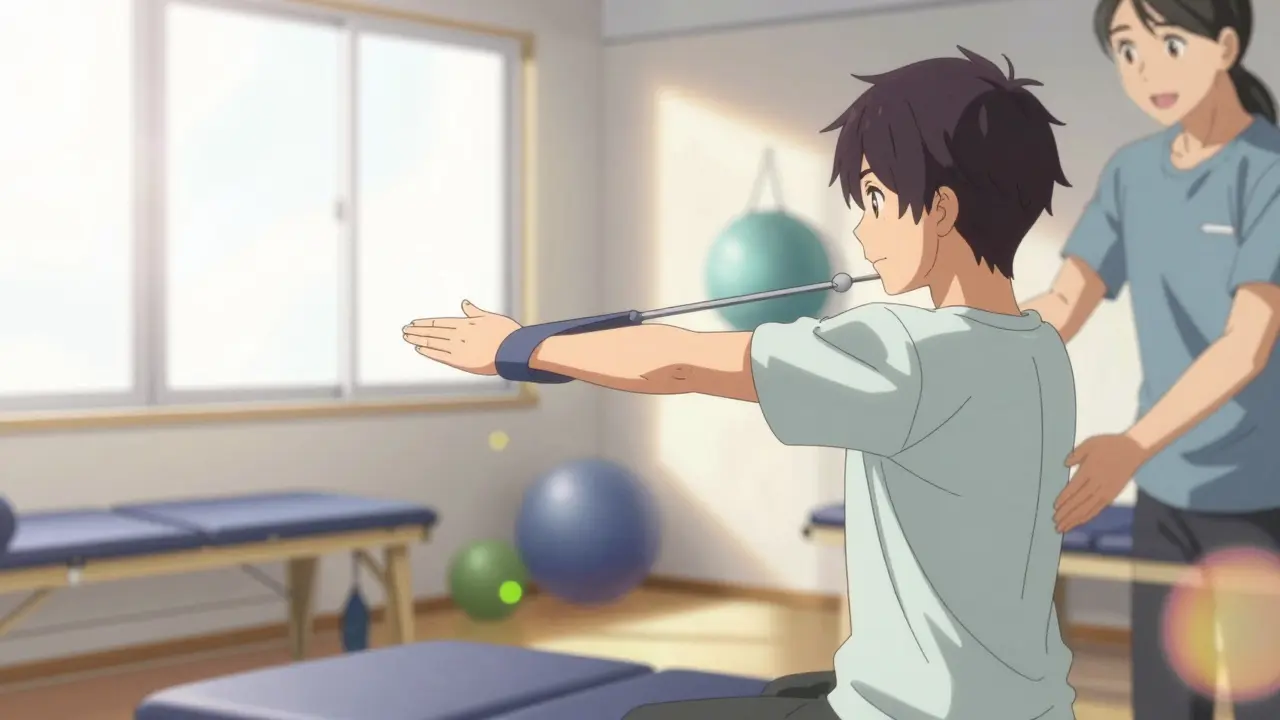
Home care is vital post-treatment. Physical therapy regimens typically require 2-3 sessions weekly for 6-8 weeks. At home, dedicate 5-10 minutes, 4-6 times daily, to extension exercises. Use a goniometer app like "Hand Meter" to track your progress; these apps correlate 95% with clinical measurements. Consistency is key. Patients who complete over 80% of their prescribed therapy regain 95% of their pre-contracture range of motion, compared to just 75% for those who skip sessions.
Frequently Asked Questions
Is Dupuytren’s contracture hereditary?
Yes, genetics play a major role. If you have a first-degree relative with the condition, your risk increases to 68%. Specific genetic markers on chromosomes 16q and 20q have been identified as contributing factors.
Can Dupuytren’s contracture be reversed naturally?
No, there is no natural cure. Once the fascia has formed cords and contracted, it will not resolve on its own. Home exercises can help maintain flexibility but cannot reverse established contractures.
How much does treatment for Dupuytren’s cost?
Costs vary widely. Needle aponeurotomy ranges from $1,500 to $3,000. Collagenase injections cost between $3,500 and $5,000 per treatment. Open fasciectomy is the most expensive, ranging from $8,000 to $15,000, depending on complexity and rehabilitation needs.
Which finger is most commonly affected?
The ring finger is the most commonly affected, followed closely by the little finger. Together, they account for the majority of cases, while the thumb is rarely involved.
Does smoking make Dupuytren’s worse?
Yes, smoking is a significant risk factor. Smokers tend to have more severe disease progression and higher recurrence rates after treatment compared to non-smokers.