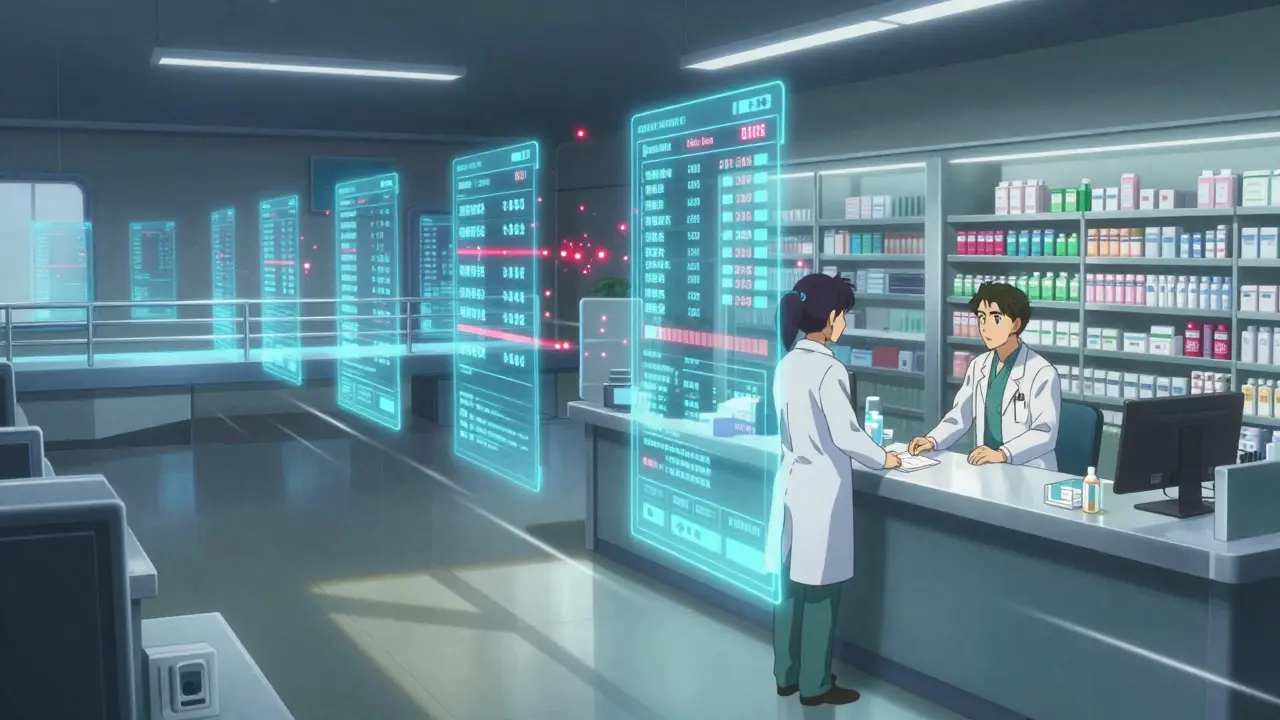
Imagine this: your doctor writes a prescription for blood pressure medication. You take it to your local pharmacy. But the pharmacist doesn’t know you’re also taking a blood thinner, or that your last lab test showed your kidneys are struggling. That’s not because they’re careless - it’s because their system is completely disconnected from your doctor’s. This gap is real, and it’s dangerous. But there’s a solution: EHR integration between pharmacies and providers.
What EHR Integration Actually Does for Prescriptions
EHR integration means your doctor’s electronic health record talks directly to your pharmacy’s system. It’s not just about sending a prescription electronically - that’s been around for years. True integration is two-way. When your doctor updates your meds, your pharmacy sees it. When your pharmacist spots a drug interaction or adjusts your dose, that info flows back to your doctor’s screen. No more phone calls, no more faxes, no more guesswork.
This isn’t science fiction. It’s happening in clinics and pharmacies across the U.S. The NCPDP SCRIPT standard handles the actual prescription transmission, while HL7 FHIR Release 4 moves the bigger picture: lab results, allergies, past prescriptions, even care plans from your pharmacist. The goal? To make sure everyone who touches your meds has the same, up-to-date information.
Why This Matters More Than You Think
Here’s what happens when systems don’t talk:
- You get prescribed a new antibiotic, but your pharmacist doesn’t know you’re allergic to a similar drug from five years ago.
- Your diabetes meds get changed, but your pharmacy still bills for the old dose - and you get charged the wrong amount.
- Your heart failure meds are doubled by your cardiologist, but your primary care doctor doesn’t know, so they add another drug that clashes.
These aren’t hypotheticals. Research from the University of Tennessee showed that when EHR integration was in place, medication-related hospital readmissions dropped by 31%. Another study found pharmacists with full EHR access caught 4.2 medication problems per patient visit - nearly triple the 1.7 they caught without it.
And it’s not just safety. It’s speed. A prescription that used to take 15 minutes to process - calling the doctor, checking insurance, waiting for prior auth - now takes 5.6 minutes. That’s a 63% time savings. For a pharmacy doing 200 scripts a day, that’s over 15 hours saved every week.
Who’s Doing It Right - And Who’s Not
The gap between big systems and small pharmacies is massive. About 89% of pharmacies tied to hospitals or big health networks have full EHR integration. Only 12% of independent community pharmacies do.
Why? Cost. Setting up integration can run $15,000 to $50,000 upfront for a small pharmacy. Then there’s $5,000 to $15,000 a year in maintenance. For a mom-and-pop shop making $500,000 a year in revenue, that’s a huge chunk. And it’s not just money - it’s time. Pharmacists already average just 2.1 minutes per patient. Where’s the time to dig through EHR data?
Then there’s the tech mess. There are over 120 different EHR systems and 50 pharmacy software platforms in the U.S. Getting them to speak the same language isn’t plug-and-play. One pharmacy might use Epic, another uses Cerner, and the third uses a local system no one else recognizes. Mapping data between them takes weeks - sometimes months - of manual work.
The Real-World Impact: Stories from the Front Lines
A pharmacist in East Tennessee used to spend hours on the phone with doctors trying to get prior authorizations approved. After integrating with Epic through Surescripts, that process dropped from 48 hours to 4. That’s a game-changer for patients who need meds now, not next week.
But not all stories are smooth. One independent pharmacy owner in Ohio spent $18,500 and seven months to get integrated - only to find that their EHR vendor’s documentation was so poor, the system kept dropping key data like allergies. They’re still fixing glitches two years later.
On the positive side, users of platforms like SmartClinix and DocStation praise seamless integration with major EHRs. But many also complain about alert fatigue - too many pop-ups warning about drug interactions, most of which turn out to be false alarms. That’s a design flaw, not a system failure. Too many alerts mean pharmacists start ignoring them.
What’s Changing in 2025 - And What’s Still Broken
Regulations are pushing change. The 21st Century Cures Act bans information blocking - meaning providers can’t legally refuse to share data with pharmacies anymore. Medicare Part D plans now have to include EHR-integrated medication therapy management to get high Star Ratings. California’s SB 1115 requires full integration by 2026.
But here’s the catch: only 19 states have payment models that reimburse pharmacists for the time they spend reviewing EHR data and adjusting care plans. In 29 states, a pharmacist can spot a dangerous interaction, call the doctor, and fix it - but they won’t get paid for it. That’s why Dr. Lucinda Maine of the American Association of Colleges of Pharmacy says integration is still a luxury, not a standard.
Meanwhile, new tech is emerging. The CARIN Blue Button 2.0 system lets patients download their own data and send it to their pharmacy. NCPDP is rolling out PeCP Version 2.0 in late 2024, with smarter clinical decision support. And CVS and Walgreens are testing AI tools that scan integrated data to flag high-risk patients before problems even happen - reducing missed interventions by 37% in early pilots.
What You Can Do - Whether You’re a Pharmacist or a Patient
If you’re a pharmacist in an independent shop:
- Start with Surescripts. It’s the most widely used gateway, with 97% of U.S. pharmacies connected.
- Ask your EHR vendor if they support HL7 FHIR R4 and NCPDP SCRIPT 2017071. If not, push for it.
- Apply for state or federal grants. Some states offer funding for small pharmacy tech upgrades.
- Train your staff. Integration isn’t just tech - it’s workflow. If your team doesn’t know how to use the data, it’s useless.
If you’re a patient:
- Ask your pharmacist: “Do you have access to my doctor’s records?” If they say no, ask why.
- Use your health portal. Download your medication list and lab results, and bring them to your pharmacy.
- Let your doctor know you want your pharmacy included in your care team. It’s your right under the Cures Act.
The Future Isn’t Just Connected - It’s Predictive
Integration isn’t the end goal. It’s the foundation. The next step is prediction. AI won’t just flag a drug interaction - it’ll spot that you’re likely to stop taking your statin because of muscle pain, and suggest a lower dose before you quit. It’ll know your refill pattern and warn your doctor you’re running low before you get sick.
But none of that matters if pharmacies can’t afford to connect, or if pharmacists aren’t paid to use the data they’re given. Right now, we have the tech. We have the proof. What we’re missing is the will - and the payment model - to make this standard for everyone, not just the big players.
When your doctor, your pharmacist, and your record all speak the same language, you don’t just get better care. You get safer care. And that’s not a feature. It’s the baseline.
What is EHR integration in pharmacy practice?
EHR integration in pharmacy practice means the electronic health record system used by your doctor connects directly with your pharmacy’s software. This allows two-way sharing of medication lists, lab results, allergies, and care plans. Instead of relying on phone calls or faxes, pharmacists can see what your doctor prescribed, and your doctor can see what the pharmacist changed or advised - leading to safer, more coordinated care.
How does EHR integration reduce medication errors?
EHR integration reduces medication errors by giving pharmacists real-time access to full patient records, including allergies, kidney or liver function, and other medications. Automated alerts flag dangerous interactions, duplicate prescriptions, or incorrect doses before the drug is dispensed. Studies show this cuts medication errors by up to 48%. One study found pharmacists caught 4.2 medication problems per patient visit with integration - nearly triple the rate without it.
Why don’t all pharmacies have EHR integration?
Cost is the biggest barrier. Independent pharmacies face $15,000 to $50,000 in setup fees and $5,000 to $15,000 yearly in maintenance. Many also lack the technical staff to handle complex HL7 FHIR and NCPDP SCRIPT standards. With over 120 different EHR systems and 50 pharmacy platforms, getting them to communicate is technically challenging. Only 12% of independent pharmacies have full integration, compared to 89% of hospital-linked pharmacies.
What standards are used for EHR-pharmacy communication?
The NCPDP SCRIPT standard (version 2017071) handles electronic prescription transmission. For broader data exchange - like lab results, allergies, and care plans - HL7 FHIR Release 4 (R4) is the modern standard. The Pharmacist eCare Plan (PeCP), built on FHIR, lets pharmacists share their clinical recommendations directly in the EHR. Security follows HIPAA rules with AES-256 encryption and TLS 1.2+ for data transfer.
Can patients access their own EHR data to help their pharmacy?
Yes. The CARIN Blue Button 2.0 system, launched in January 2024, lets patients download their medication history, lab results, and claims data from their insurer or provider portal and send it directly to their pharmacy. This is especially helpful if your pharmacy doesn’t yet have full EHR integration - you can still help close the information gap.
Is EHR integration required by law?
Not directly - but strong incentives and penalties exist. The 21st Century Cures Act bans information blocking, meaning providers can’t legally refuse to share data with pharmacies. Medicare Part D plans must have integrated pharmacy communication to qualify for high Star Ratings. California requires full integration for medication therapy management by 2026. So while it’s not mandatory everywhere, the pressure to adopt is growing fast.


anggit marga
January 2, 2026 AT 10:12