
The Foundation of Generic Stability
The rules for generics are largely shaped by the Hatch-Waxman Act, which created the Abbreviated New Drug Application (or ANDA) pathway. Because generic makers don't have to repeat the massive clinical trials of the original brand, they must instead prove their version is "bioequivalent" and stays stable. This is governed by the International Council for Harmonisation (specifically ICH Q1A(R2)), which sets the global gold standard for how drugs are tested.
To satisfy the FDA, you can't just test one batch. You need data from at least three primary batches. These batches must be made at a pilot scale and follow current Good Manufacturing Practices (cGMP), which are the regulations found in 21 CFR Parts 210 and 211. If your batches aren't made according to these standards, the FDA will likely toss your data out.
Testing Protocols and Timelines
The FDA wants to see how your drug handles different environments. This is split into two main types of studies: accelerated and long-term. If you're proposing a shelf life of 12 months or more, your testing schedule needs to be rigid. In the first year, you test every 3 months; in the second year, every 6 months; and then annually after that.
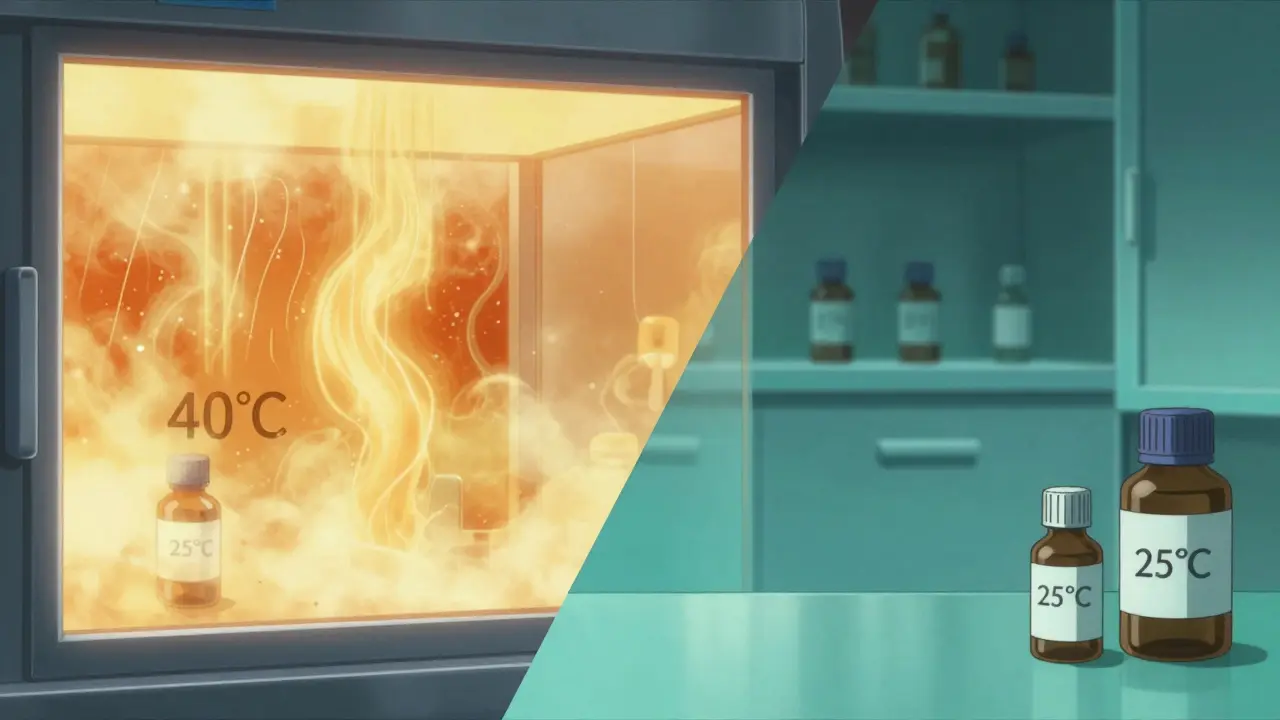
Accelerated studies are designed to "stress" the drug. They typically require 6 months of data at 40°C ± 2°C with 75% ± 5% relative humidity. This helps predict how the drug will behave if it's shipped in a hot truck or stored in a humid warehouse. Long-term studies are more realistic, usually sitting at 25°C ± 2°C and 60% ± 5% relative humidity. For an ANDA submission, you generally need 12 months of long-term data to establish a baseline.
| Study Type | Temperature | Relative Humidity | Required Data for Submission |
|---|---|---|---|
| Accelerated | 40°C ± 2°C | 75% ± 5% | 6 Months |
| Long-Term | 25°C ± 2°C | 60% ± 5% | 12 Months |
| Intermediate | 30°C ± 2°C | 65% ± 5% | As required by specific drug profile |
What Exactly Are They Testing?
The FDA isn't just looking for the drug to "look okay." They require a deep dive into physical, chemical, biological, and microbiological attributes. For example, if your drug uses an antimicrobial preservative, you have to prove that the concentration of that preservative doesn't drop below effective levels over time.
One of the biggest pitfalls is the failure to validate "stability-indicating methods." A method is stability-indicating if it can detect a change in the drug's purity or potency without being confused by degradation products. If your testing method can't tell the difference between the active drug and its breakdown products, your data is useless. This specific failure is cited in about 31.2% of stability-related CRLs.
Generics vs. Brand-Name Requirements
You might wonder if generic makers get a break. In some ways, they do. Generic manufacturers can reference the stability data of the Reference Listed Drug (RLD) to help support their shelf-life claims. Since the RLD's degradation pathways are already well-known, generic companies often don't need to perform the same level of forced degradation studies that an innovator drug would.
However, the FDA still requires formal studies on the specific generic formulation. Even a tiny change in an inactive ingredient (excipient) can change how a drug degrades. This is where many companies stumble; they assume that because the brand name is stable, their version will be too, without providing the hard data to prove it.
Common Pitfalls and How to Avoid Them
A huge number of stability failures aren't actually about the drug-they're about the equipment and the paperwork. Temperature excursions in stability chambers are incredibly common. In some inspections, the FDA found that temperature deviations exceeding ±2°C accounted for nearly 18.4% of data invalidations. If your chamber spikes or dips, you risk losing months of data.
To fix this, top manufacturers are moving toward automated environmental monitoring systems. Another common issue is the "completeness assessment" phase. The FDA often rejects applications because the stability protocol is missing or vague. To avoid this, ensure your protocol specifically references USP (United States Pharmacopeia) chapters like <1151> Pharmaceutical Dosage Forms. If you're unsure, conducting a pre-study protocol review with the FDA can reduce your deficiency rate by over 40%.

The Shifting Regulatory Landscape
The goalposts are moving. Recent draft guidances suggest the FDA may increase the requirement for new ANDAs from 12 months of stability data to 24 months. There is also a push toward Quality by Design (QbD), where stability is built into the product development process rather than just tested at the end.
We are also seeing a shift in how data is tracked. There are pilot programs using blockchain for stability data verification to prevent data tampering and ensure transparency. For those moving into biosimilars, be prepared for even higher costs-stability testing for biosimilars can be 37.5% more expensive than for small-molecule generics due to the complexity of the molecules.
How many batches are required for FDA stability testing?
The FDA requires stability studies to be conducted on at least three primary batches of the drug product. These batches must be manufactured at a minimum pilot scale and comply with current Good Manufacturing Practices (cGMP).
What is the difference between accelerated and long-term stability testing?
Accelerated testing uses high temperature (40°C) and humidity (75% RH) to predict long-term degradation over a short period (typically 6 months). Long-term testing uses conditions that mimic intended storage (e.g., 25°C and 60% RH) and must be conducted throughout the proposed shelf life of the drug.
Can I use bracketing or matrixing in my stability design?
Yes, bracketing and matrixing designs can be used to reduce the number of samples tested across different strengths or container sizes, but only if you can scientifically justify the design and it is approved by the FDA.
What happens if my stability chamber has a temperature excursion?
Temperature excursions exceeding ±2°C can lead to the invalidation of your stability data. It is critical to have automated monitoring and a clear deviation protocol to document and address these events.
Why is a "stability-indicating method" so important?
A stability-indicating method is essential because it can accurately measure the active ingredient without interference from degradation products or impurities. Without this, the FDA cannot be sure if the drug is actually staying potent or if the test is simply missing the degradation.
Next Steps and Troubleshooting
If you are currently preparing an ANDA, start by auditing your stability chambers. If you're relying on manual logs, switch to an automated system immediately to avoid the common pitfalls that lead to 483 observations. For those with a history of CRLs, I suggest a complete review of your sampling plans-nearly 23% of stability deficiencies stem from poor sampling.
Depending on your role, your focus will differ:
- Quality Control Managers: Focus on the validation of stability-indicating methods and the calibration of sensors.
- Regulatory Affairs Specialists: Ensure the stability protocol explicitly maps to ICH Q1A(R2) and USP guidelines to pass the completeness assessment.
- Operations Leads: Verify that the three batches used for testing were manufactured at a scale that truly represents the final commercial process.


Trey Kauffman
April 9, 2026 AT 11:47