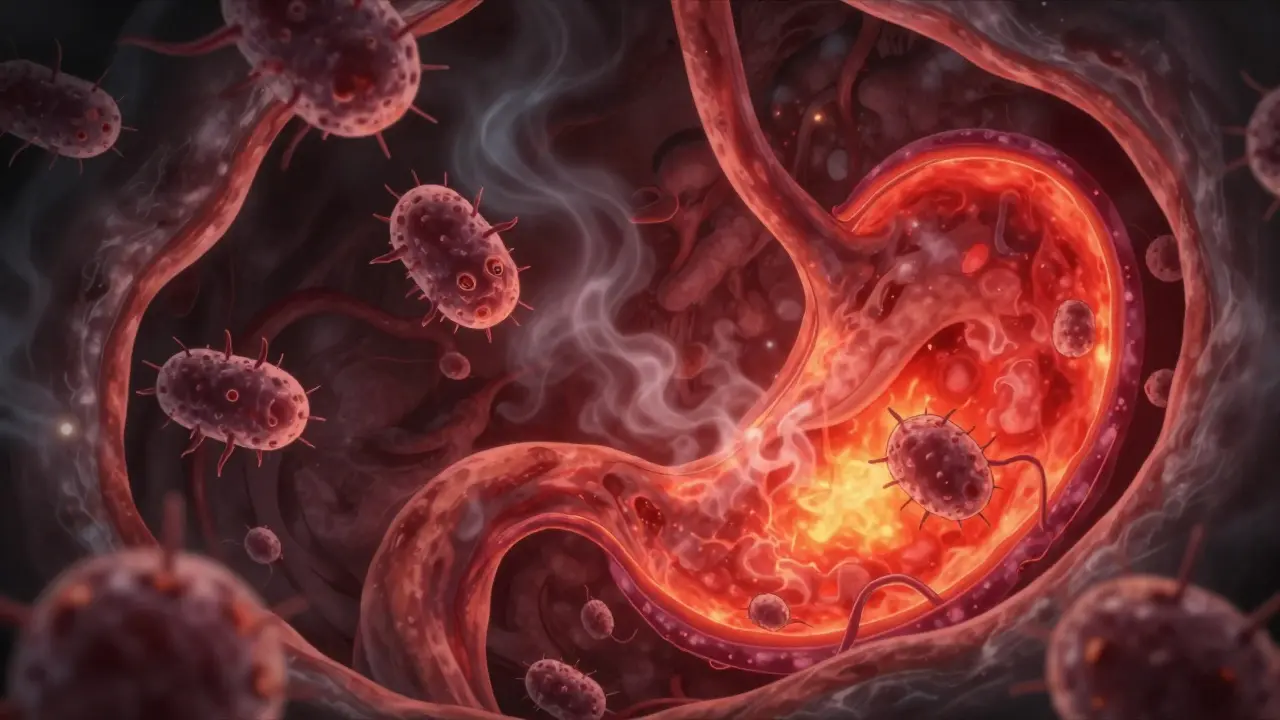
When your stomach feels like it’s on fire, even a sip of water hurts, and you’re constantly nauseous or bloated, it’s not just "indigestion." It could be gastritis - inflammation of the stomach lining. This isn’t a one-time glitch. Left untreated, it can lead to ulcers, bleeding, or even raise your risk of stomach cancer. And in most cases, the culprit is a tiny, hard-to-detect bacteria: Helicobacter pylori.
What Exactly Is Gastritis?
Your stomach lining, called the mucosa, is designed to handle strong acid and enzymes. It’s protected by a thick layer of mucus. But when that barrier breaks down - from infection, drugs, stress, or autoimmune issues - the acid starts eating away at the tissue. That’s gastritis. There are two main types: erosive and nonerosive. Erosive gastritis means there are actual breaks or sores in the lining. You might see blood in your vomit or notice black, tarry stools - signs of internal bleeding. Nonerosive gastritis doesn’t show visible damage, but the cells underneath are still inflamed. This one sneaks up on you. Many people don’t feel anything until it’s advanced. About 70% to 90% of stomach ulcers are tied to H. pylori. That’s not a small percentage - it’s the rule, not the exception. The bacteria stick to the stomach wall, survive the acid, and trigger a slow-burning fire of inflammation. In fact, the discovery of H. pylori in 1982 by two Australian doctors changed everything. Before that, doctors thought stress and spicy food caused ulcers. They were wrong.Who Gets Gastritis - And Why?
It’s not just older people. While about half of adults over 60 have some level of chronic gastritis, younger folks get it too. Here’s who’s most at risk:- People who take NSAIDs like ibuprofen or aspirin regularly - especially daily. These drugs block the protective mucus layer.
- Heavy drinkers. More than 30 grams of alcohol a day (about two standard drinks) doubles your risk.
- Those with H. pylori infection. In the UK, about 1 in 3 people carry it, but most never know.
- People with autoimmune conditions like Hashimoto’s thyroiditis. Their immune system mistakenly attacks the stomach lining.
- Smokers. Quitting can improve healing by 35%.
How Do You Know If It’s Gastritis?
Symptoms vary wildly. Some people get:- Sharp or burning pain in the upper belly - often worse after eating
- Nausea and vomiting - sometimes with blood or coffee-ground-looking material
- Bloating and feeling full too fast
- Loss of appetite
- Black, sticky stools (melena) - a red flag for internal bleeding
- Fatigue, dizziness, pale skin - signs of anemia from slow bleeding
The Gold Standard: Diagnosis
There’s no blood test that confirms gastritis. The only way to know for sure is through an endoscopy - a thin tube with a camera is passed down your throat to look at your stomach lining. During the procedure, the doctor takes tiny tissue samples (biopsies). These are checked for H. pylori, signs of atrophy, or abnormal cell changes. But you don’t always need the scope. If H. pylori is suspected, non-invasive tests work well:- Urea breath test: You drink a special solution. If H. pylori is present, it breaks down the urea and releases carbon dioxide you breathe out. This test is 95% accurate.
- Stool antigen test: Looks for H. pylori proteins in your poop. Cheap, reliable, and used often in clinics.
- Blood test: Checks for antibodies, but can’t tell if you still have the infection - just if you’ve ever had it.

H. pylori Treatment: The Real Game-Changer
If you have H. pylori, you don’t just treat the symptoms - you kill the bacteria. That’s the only way to stop the inflammation for good. Standard treatment is called triple therapy: a proton pump inhibitor (PPI) like omeprazole or esomeprazole, plus two antibiotics - usually amoxicillin and clarithromycin - taken together for 10 to 14 days. But here’s the problem: antibiotics are failing more often. In the U.S., clarithromycin resistance has jumped from 10% in 2000 to 35% in 2023. That means one in three people on standard triple therapy won’t be cured. Newer options are changing the game:- Bismuth quadruple therapy: PPI + bismuth + metronidazole + tetracycline. Used in areas with high clarithromycin resistance. Success rate: 85-92%.
- Vonoprazan: A newer acid blocker approved in 2022. Works better than PPIs at suppressing acid. One study showed 90.3% eradication rate vs. 75.6% for standard therapy.
- Sequential or concomitant therapy: Different antibiotics given in stages or all at once. Used when first-line fails.
What About NSAIDs and Alcohol?
If your gastritis is from ibuprofen, naproxen, or daily aspirin, stopping them is the first step. Your doctor might switch you to acetaminophen (paracetamol) for pain. If you need an anti-inflammatory long-term, they may prescribe a COX-2 inhibitor like celecoxib, which is gentler on the stomach - but still needs a PPI for protection. Alcohol? Cut it out. Even moderate drinking irritates the lining. Studies show symptoms drop by 60% within two weeks of quitting. And if you smoke? Quitting helps healing by 35%. No magic pill beats that.Autoimmune Gastritis: A Different Beast
This one’s rare - affects less than 1% of people - but it’s serious. Your immune system attacks the cells that make stomach acid and intrinsic factor. No intrinsic factor means no vitamin B12 absorption. That leads to pernicious anemia. Treatment? No antibiotics. Instead, lifelong B12 shots or high-dose oral supplements. Left untreated, it can lead to nerve damage or stomach cancer. If you have Hashimoto’s, pernicious anemia, or vitiligo, ask your doctor to test for autoimmune gastritis.What Happens After Treatment?
Many people feel better in days. PPIs reduce acid fast - often within 24 hours. But healing the lining? That takes weeks. You can’t just stop the meds after feeling okay. Here’s what most patients don’t know: stopping PPIs too soon can cause rebound acid hypersecretion. Your stomach overcompensates and makes even more acid than before. That’s why 40% of long-term users struggle to quit. The fix? Taper slowly. Don’t go from daily omeprazole to nothing. Reduce by half a dose every week. Talk to your doctor about switching to H2 blockers like famotidine for maintenance.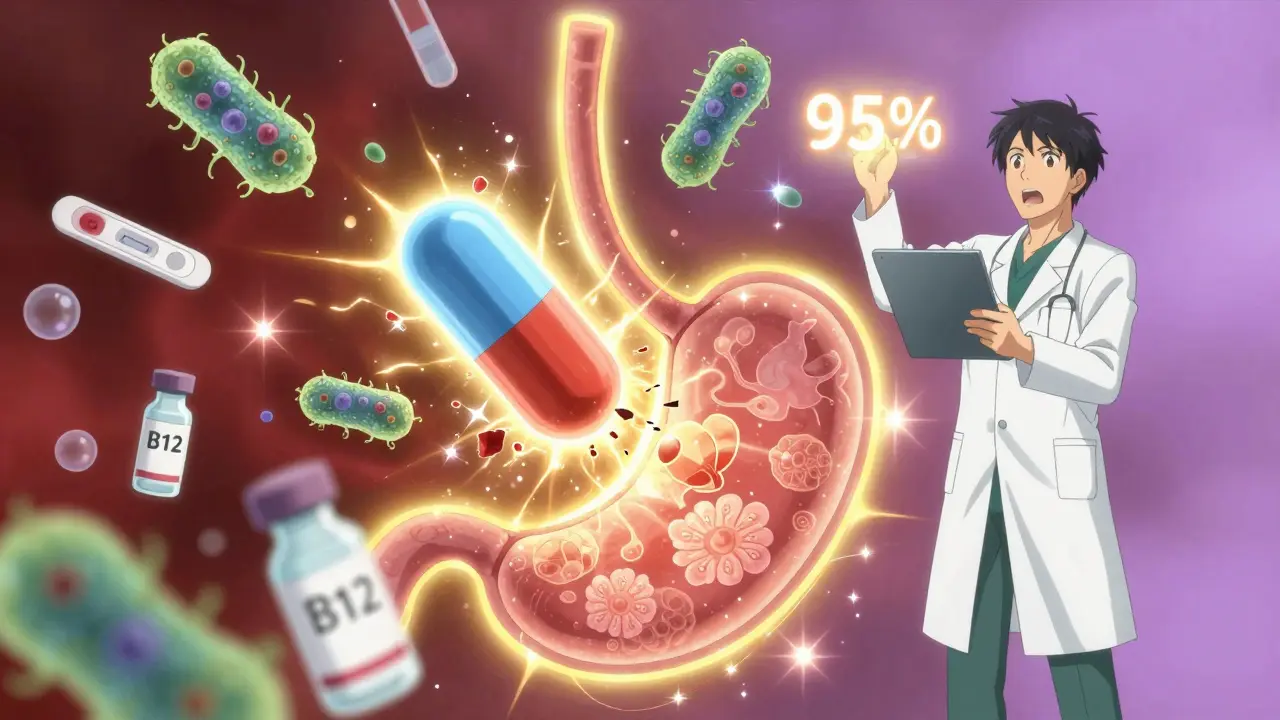
When to Worry - Red Flags
Don’t ignore these:- Vomiting blood or coffee-ground material
- Black, tar-like stools
- Unexplained weight loss
- Difficulty swallowing
- Persistent vomiting
- Fatigue with pale skin or shortness of breath
Lifestyle: What Helps Beyond Medicine
Medicine fixes the cause. But your habits keep it from coming back.- Switch to a Mediterranean-style diet: vegetables, fish, olive oil, whole grains. Avoid fried, spicy, or overly acidic foods.
- Eat smaller, more frequent meals. A full stomach puts pressure on the lining.
- Don’t lie down for 3 hours after eating.
- Manage stress. Chronic stress worsens inflammation, even if it doesn’t cause it.
- Limit caffeine. Coffee, energy drinks, and even tea can irritate the stomach.


Alec Stewart Stewart
February 3, 2026 AT 22:18