
Getting the right dose of medicine for your child isn’t just important-it can be life-saving. A mistake of just one milliliter can mean the difference between treatment and harm. Studies show that 7 in 10 parents mismeasure liquid medications at home, often using kitchen spoons or dosing cups that aren’t accurate. The good news? With the right tools and a few simple steps, you can eliminate that risk completely.
Why Milliliters (mL) Are the Only Unit That Matters
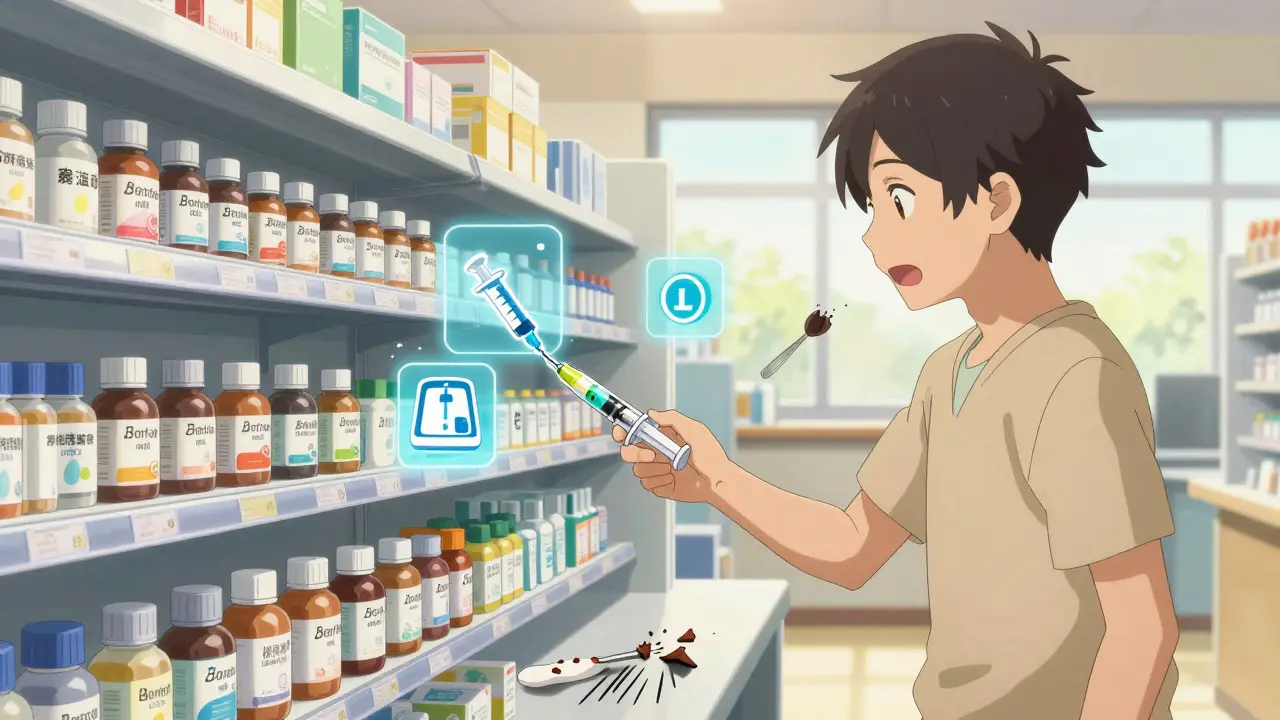
Never use teaspoons, tablespoons, or any household measuring tool. Even though some medicine bottles still list doses in teaspoons, those are outdated and dangerous. A household teaspoon can hold anywhere from 3.9 to 7.3 milliliters-way off from the standard 5 mL. That’s a 20% to 200% error. For a child, that’s not a small mistake. It’s a risk of overdose or underdose.
The CDC and the American Academy of Pediatrics have been clear since 2015: all pediatric liquid medications should be measured only in milliliters (mL). No more teaspoons. No more tablespoons. Just mL. This rule exists because the difference between 0.5 mL and 5 mL is ten times. One looks like a tiny drop. The other fills a syringe. Mix them up, and you could give your child a fatal dose.
The Right Tools for the Job
Not all measuring tools are created equal. Here’s what works-and what doesn’t.
- Oral syringes (1-10 mL): These are the gold standard. They’re precise, easy to control, and let you measure exactly what’s needed-even for tiny doses under 5 mL. Studies show they’re 94% accurate. For doses under 5 mL, they’re the only tool you should use.
- Dosing cups (5-30 mL): These are okay for older kids who can drink directly from the cup, but they’re unreliable for small doses. At 2.5 mL, error rates jump to nearly 70%. If you use one, make sure it’s marked only in mL and that you read the line at eye level.
- Droppers: Good for newborns or tiny doses. But they’re harder to control. Always check the markings. Some droppers are labeled in mL, others in drops-which vary by liquid thickness and nozzle size. Stick to mL.
- Medication spoons: These are sometimes included with prescriptions. They’re usually 5 mL, but they’re still not as accurate as a syringe. Don’t rely on them for critical meds like antibiotics or pain relievers.
- Kitchen spoons: Never use them. Not even once. A dinner spoon can hold twice as much as a teaspoon. It’s not worth the risk.
Many pharmacies now include an oral syringe with liquid prescriptions. If they don’t, ask for one. It’s free. And if your child’s medication comes with a syringe, use that one-never swap it out for another.
How to Measure Accurately with an Oral Syringe
Using an oral syringe is simple, but most people do it wrong. Here’s how to get it right every time:
- Shake the bottle well before measuring. Many liquid medicines settle. If you don’t shake, you might give your child only half the dose.
- Remove the cap and insert the syringe into the bottle. Turn the bottle upside down.
- Slowly pull the plunger until the top edge of the black rubber tip lines up with the dose you need. Don’t look at the side of the syringe-look straight on at the line.
- Hold the syringe upright and check again. The liquid should form a slight curve (called a meniscus). Read the measurement at the bottom of that curve.
- Give the medicine slowly into the side of your child’s mouth, near the cheek. This avoids triggering the tongue-thrust reflex that causes spitting.
- Wash the syringe with warm water after each use. Let it air dry. Don’t store it capped with medicine inside.
Pro tip: Use a permanent marker to write the dose on the syringe if your child takes the same amount daily. For example, write “2.5 mL” near the tip. That way, even if you’re tired or in a rush, you can’t misread it.
Weight-Based Dosing: When the Prescription Says mg/kg
Many pediatric medications are dosed by weight-not age. The label might say “40 mg/kg/day.” That means you need to know your child’s weight in kilograms (kg), not pounds.
To convert pounds to kilograms: divide by 2.2.
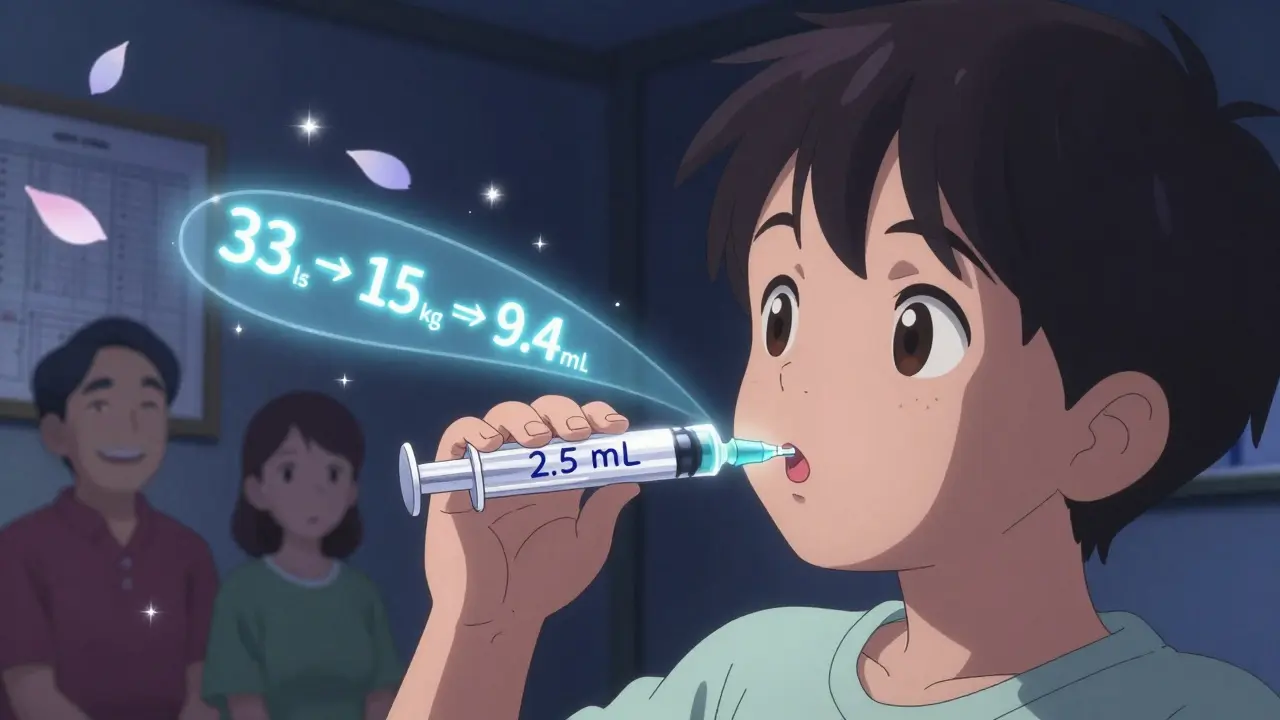
Example: Your child weighs 33 pounds.
33 ÷ 2.2 = 15 kg
If the dose is 15 mg/kg per dose, then:
15 mg × 15 kg = 225 mg per dose
Now check the concentration on the bottle. Say it’s 120 mg per 5 mL.
225 mg ÷ 120 mg = 1.875
1.875 × 5 mL = 9.375 mL
So you give 9.4 mL. Round to the nearest tenth. Use a syringe that shows 0.1 mL marks. Don’t guess.
If you’re unsure, ask your pharmacist to write the dose in mL on the label. Many still don’t do this-but you can request it. The CDC says pharmacies should include both mg and mL on every pediatric prescription.
Common Mistakes Parents Make (And How to Avoid Them)
Here are the most frequent errors-and how to fix them:
- Mixing up mg and mL: These are totally different. Milligrams (mg) measure the amount of drug. Milliliters (mL) measure the volume of liquid. Confusing them causes 36% of pediatric dosing errors. Always double-check the label.
- Not shaking the bottle: Antibiotics and other suspensions sink to the bottom. If you don’t shake, your child gets less medicine. Shake for 10 seconds before every dose.
- Using the wrong syringe: Don’t reuse a syringe from another medicine. Clean it well, or use a new one. Cross-contamination can affect how the medicine works.
- Guessing based on age: A 2-year-old and a 4-year-old can weigh very differently. Always use weight, not age, for dosing.
- Assuming a dosing cup is accurate: If the cup has both mL and tsp markings, throw it out. Use only mL-marked tools.
What to Do When Your Child Refuses the Medicine
Most kids hate the taste. That’s normal. But forcing it or mixing it into a full bottle of milk or juice can lead to underdosing.
Try these proven tricks:
- Use a syringe to squirt the medicine slowly into the side of the mouth. Don’t aim for the back of the throat-it can trigger gagging.
- Offer a small amount of apple sauce, yogurt, or ice cream right after. Don’t mix the medicine into it-give it separately.
- Use flavored syrups if available. Some pharmacies offer flavoring options for free.
- Let your child hold the syringe (if old enough). Giving them control reduces fear.
- Never use punishment or force. It creates long-term resistance to medicine.
What’s Changing in Pediatric Dosing (2026)
Things are getting better. The FDA is moving toward requiring all pediatric liquid medications to come with an oral syringe marked only in mL. By 2026, over 95% of these medicines are expected to follow this standard. Hospitals and pharmacies are already handing out free, color-coded syringes at discharge.
Smart tools are coming too. Philips Healthcare is testing dosing cups with built-in sensors that light up when the right amount is poured. Apps like MedSafety use your phone’s camera to guide you through measuring. In trials, these tools cut errors by over half.
But the biggest change isn’t tech-it’s awareness. More parents now know to ask for a syringe. More pharmacists are trained to explain mL dosing. And more schools and pediatric clinics are teaching caregivers how to measure correctly.
When to Call Your Doctor or Pharmacist
You should call if:
- The dose looks too high or too low for your child’s weight.
- The label says “tsp” or “tbsp” instead of mL.
- You’re unsure how to convert weight to dose.
- Your child vomits right after taking the medicine.
- You accidentally give too much.
Don’t wait. Even if you think it’s “just a little extra,” call. Many medications have narrow safety margins. A small overdose can cause liver damage, breathing trouble, or seizures.
Can I use a kitchen teaspoon if I don’t have a syringe?
No. Kitchen teaspoons vary in size and are not accurate. A real teaspoon holds 5 mL, but most kitchen spoons hold 3.9 to 7.3 mL. That’s a 20% to 200% error. For children, this can be dangerous. Always use an oral syringe or dosing cup marked in mL.
Why does the medicine label say both mg and mL?
The mg tells you how much active drug is in the dose. The mL tells you how much liquid to give. You need both to calculate the right amount. For example, 200 mg of amoxicillin might be in 5 mL of liquid. So you give 5 mL to get 200 mg. Never confuse the two numbers.
Is it okay to use a syringe from a different medicine?
Only if it’s thoroughly cleaned. Residue from other medicines can react or reduce effectiveness. It’s safer to use the syringe that came with the current medicine or get a new one from the pharmacy. Most pharmacies give them for free.
What if my child spits out most of the medicine?
Don’t give another full dose. Call your doctor. Giving too much can be dangerous. Instead, try giving smaller amounts more slowly, or mix the medicine with a tiny bit of food right before giving it. Never mix it into a full bottle or bowl.
Do I need to refrigerate liquid medicine?
Only if the label says so. Most liquid antibiotics and pain relievers are fine at room temperature. Refrigerating them can make them taste worse, which makes kids refuse them. Always check the storage instructions on the bottle.
Final Checklist for Safe Dosing
- ✅ Always measure in mL, never teaspoons or tablespoons
- ✅ Use an oral syringe for doses under 5 mL
- ✅ Shake the bottle before every dose
- ✅ Read the meniscus at eye level
- ✅ Convert weight from pounds to kilograms (divide by 2.2)
- ✅ Ask your pharmacist to write the dose in mL on the label
- ✅ Never guess-call if you’re unsure
Medication errors in children are preventable. You don’t need to be a doctor or a nurse. You just need to use the right tool, read the label carefully, and never rely on guesswork. Your child’s safety depends on it.


Naresh L
February 2, 2026 AT 09:16