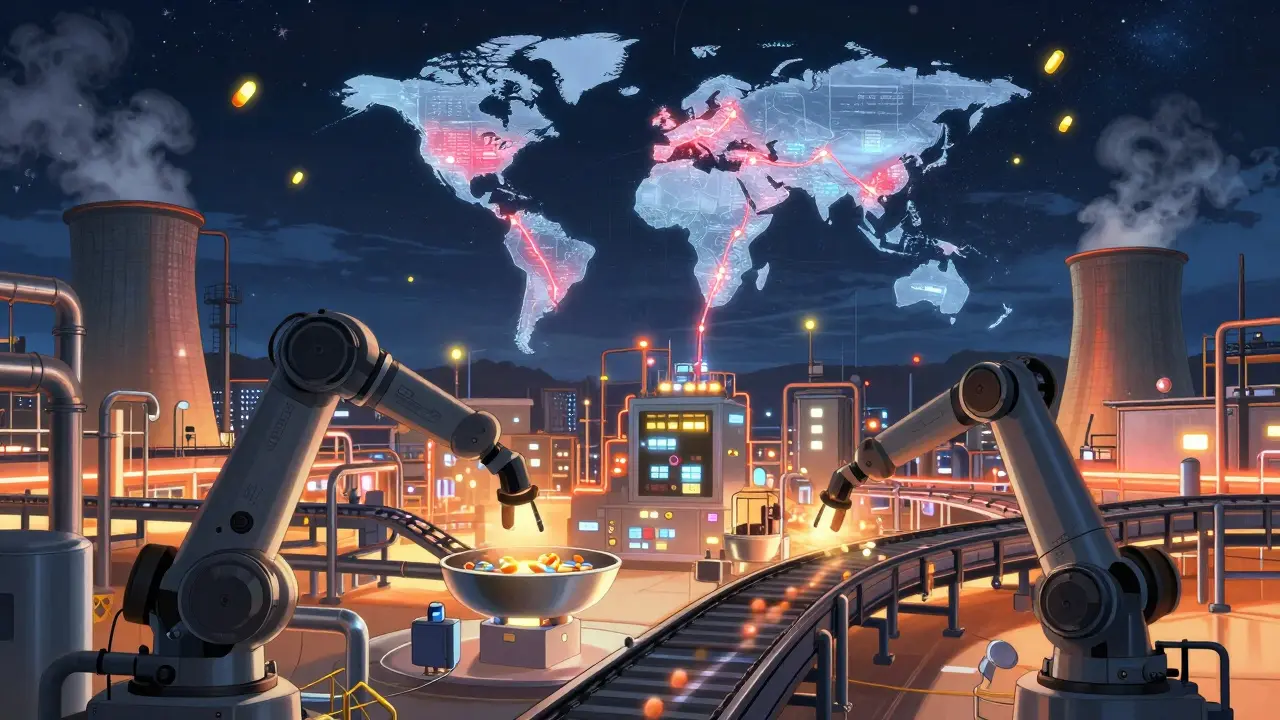
When you take a pill for high blood pressure, diabetes, or even a common antibiotic, there’s a good chance it came from India. The country doesn’t just make medicines-it supplies them to nearly every corner of the globe. More than 20% of all generic drugs shipped worldwide originate in India. That’s not a coincidence. It’s the result of decades of strategic policy, relentless cost control, and a manufacturing ecosystem built to deliver quality at scale.
How India Became the Pharmacy of the World
India’s rise as a global drugmaker didn’t happen overnight. In the 1970s, the government changed its patent laws to allow local companies to copy patented drugs as long as they used a different manufacturing process. This wasn’t about breaking rules-it was about rewriting them to serve public health. Suddenly, medicines that cost thousands of dollars in the U.S. or Europe could be made in India for a fraction of the price. By the 1990s, Indian companies like Cipla and Dr. Reddy’s began exporting these generics. When the HIV/AIDS crisis hit Africa in the early 2000s, Indian manufacturers stepped in. They produced antiretroviral drugs at $100 per patient per year-down from $10,000. That single move saved millions of lives. It also proved that high-quality, low-cost medicines could work on a global scale. Today, India produces over 60,000 generic drug formulations and more than 500 active pharmaceutical ingredients (APIs). It’s the largest vaccine producer on Earth, making over 60% of the world’s vaccines by volume. From insulin to cancer drugs to childhood vaccines, Indian factories churn out what the world needs-when it needs it.Scale, Compliance, and Infrastructure
What makes India’s system work isn’t just low cost-it’s compliance. India has over 650 U.S. FDA-approved drug plants, more than any other country outside the U.S. That’s not a small number. It means these factories meet the same strict standards as those in Ohio or New Jersey. There are also over 2,000 WHO-GMP certified facilities, allowing exports to 150+ countries. The industry isn’t just big-it’s diverse. There are more than 10,000 manufacturing units and 3,000 pharmaceutical companies. Some are giants like Sun Pharma, with a market cap of over $43 billion. Others are smaller labs specializing in complex forms: extended-release tablets, transdermal patches, sterile injections. These aren’t simple pills-they’re engineered products requiring precise chemistry and tight quality control. Indian manufacturers don’t just copy old drugs anymore. They’re now leaders in biosimilars-highly complex versions of biologic drugs like Humira or Enbrel. Companies like Biocon and Dr. Reddy’s have invested billions into this space. In 2024, biosimilars made up 8% of India’s export value, up from just 3% in 2020.Who Uses Indian Generic Drugs?
The U.S. gets 40% of its generic drugs from India. That’s nearly half of all off-patent prescriptions filled in America. In the U.K., Indian generics account for 33% of NHS prescriptions. In Sub-Saharan Africa, the number jumps to 50% of all medicines. Why? Because cost matters. In the U.S., generic drugs save patients an average of $200 billion a year. In low-income countries, they’re not a luxury-they’re a lifeline. Doctors Without Borders confirmed in 2024 that Indian-sourced antimalarials cut treatment costs by 65% while maintaining 95% efficacy in real-world conditions. Patient satisfaction is high. On PharmacyChecker.com, 87% of U.S. users who took Indian generics rated their experience positively. In the UK, NHS reviews average 4.2 out of 5. Common complaints? Taste differences or packaging that doesn’t match what they’re used to. Not safety issues.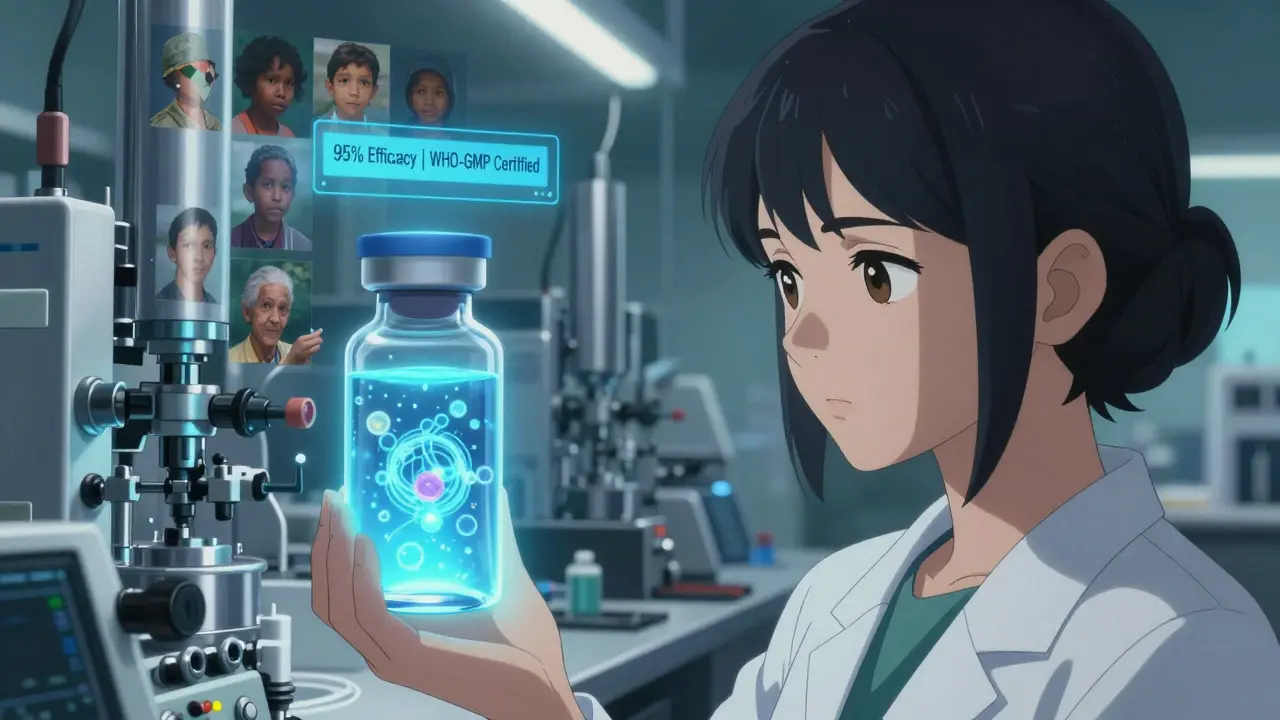
The Hidden Weakness: Dependence on China
Despite its strengths, India has a critical vulnerability: it imports 70% of its active pharmaceutical ingredients (APIs) from China. That’s a massive risk. During the pandemic, supply chain disruptions caused shortages of basic antibiotics and painkillers in India. It wasn’t a failure of manufacturing-it was a failure of raw material security. The Indian government is trying to fix this. It launched a ₹3,000 crore ($400 million) Production Linked Incentive (PLI) scheme to boost domestic API production. The goal? To cut China’s share to 53% by 2026. It’s a tall order. Building API plants takes years, billions in investment, and deep technical expertise. But if India succeeds, it won’t just protect its own supply-it could reshape global pharma.Quality Concerns and Regulatory Reality
It’s true: some Indian-made drugs have caused harm. Investigations by The Bureau of Investigative Journalism in 2025 found cases of contaminated or mislabeled products. But these are outliers. Out of billions of doses shipped, the number of verified adverse events is tiny. The bigger story is improvement. In 2015, only 60% of Indian plants passed FDA inspections. By 2024, that number jumped to 85-90%-matching global averages. The FDA now treats Indian facilities like any other: scrutinized, audited, and held to the same standard. The real challenge isn’t corruption or negligence-it’s consistency. A 2023 CII survey found that 68% of Indian manufacturers struggle with API quality variability. Another 52% say preparing for international inspections is a constant burden. Translation errors in regulatory documents still cause 22% of FDA observations.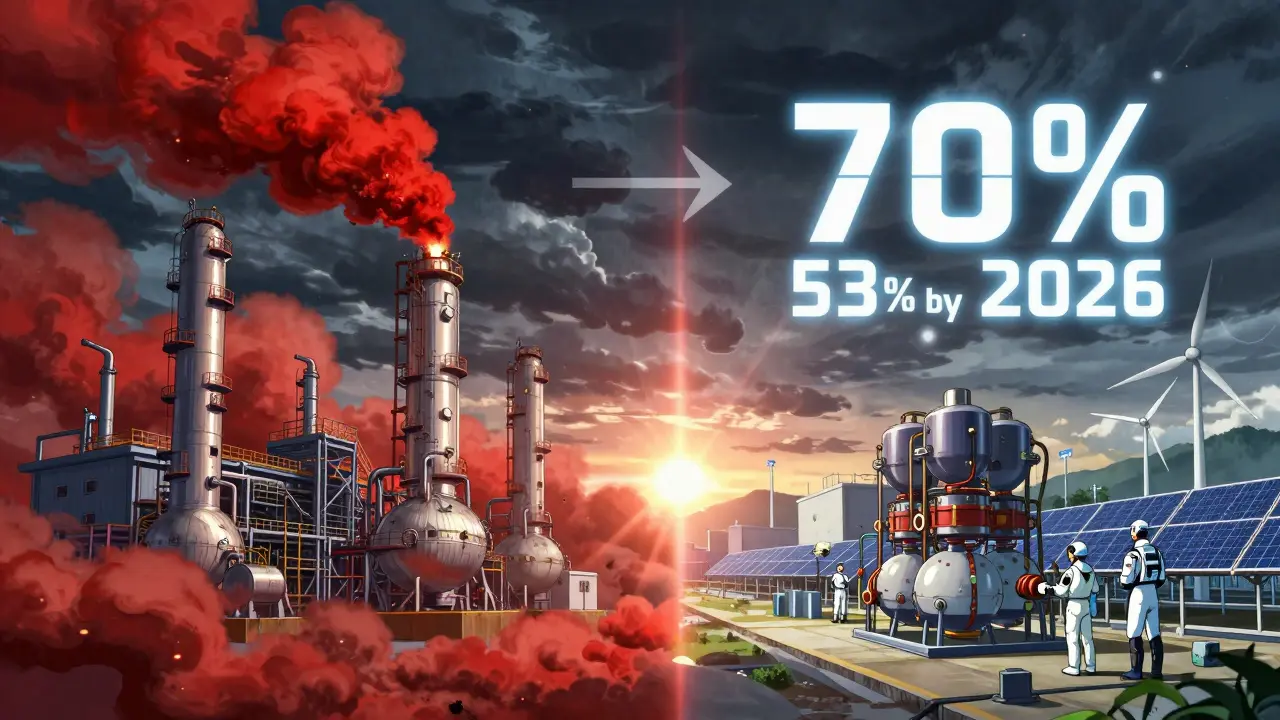
India vs. The World: Who Wins?
China makes cheaper APIs, but its factories have only 153 FDA-approved plants. Europe’s big players like Teva and Sandoz charge more and focus on niche markets. South Korea is strong in biologics but lacks India’s volume. India’s edge? It combines low cost with global compliance. No other country can match that mix. But here’s the catch: India earns only 10% of the value in the $70-80 billion U.S. generics market, even though it supplies 30% of the volume. That’s because it sells mostly low-margin, off-patent drugs. The future isn’t in selling more aspirin. It’s in selling more biosimilars, complex injectables, and specialty formulations. That’s where the profit is. India’s top companies are already shifting. Sun Pharma spends 6-8% of its revenue on R&D. That’s higher than most global generics firms.The Road Ahead: Pharma Vision 2047
In April 2024, India launched Pharma Vision 2047-a plan to turn the country into a $190 billion export powerhouse. That’s not just about making more pills. It’s about making better ones. The goal is to move from being the world’s pharmacy to becoming its innovation engine. To get there, India needs three things: full API self-sufficiency, higher-value exports, and near-perfect regulatory compliance. If it hits those targets, exports could reach $180-190 billion by 2047. If not, it risks being outpaced by countries investing in biotech and AI-driven drug discovery. For now, India remains the backbone of global access to medicine. Billions rely on it-not because it’s perfect, but because it’s reliable, affordable, and available when no one else can deliver.Are Indian generic drugs safe to take?
Yes, the vast majority are. Over 650 Indian drug plants are FDA-approved, meaning they meet the same safety and quality standards as U.S. manufacturers. While there have been rare cases of contamination or mislabeling, these are exceptions-not the norm. Patient satisfaction rates in the U.S. and U.K. are above 85%, and global health organizations like WHO and MSF regularly source medicines from India because of their proven efficacy and affordability.
Why are Indian generic drugs so much cheaper?
India doesn’t have to pay for expensive drug patents. Since its 1970 patent law change, companies can legally copy existing drugs after the patent expires. They also benefit from lower labor costs, efficient manufacturing scale, and decades of experience producing high-volume generics. This lets them cut prices by 30-80% compared to branded versions without sacrificing quality.
Do Indian generics work as well as brand-name drugs?
Yes. By law, Indian generics must prove they deliver the same amount of active ingredient into the bloodstream as the original drug. This is called bioequivalence. Studies show that over 95% of Indian generics meet this standard. Patient outcomes for conditions like hypertension, diabetes, and infections are virtually identical to those using brand-name versions.
Why does India rely on China for drug ingredients?
China dominates the global market for active pharmaceutical ingredients (APIs) because it produces them at lower cost and in massive volumes. India lacks the infrastructure and scale to make most APIs domestically. But this dependency is risky-supply chain issues during the pandemic caused shortages. India is now investing $400 million to build its own API plants and aims to cut China’s share from 70% to 53% by 2026.
What’s the difference between Indian and Chinese generic drugs?
Indian generics are made in FDA- and WHO-approved facilities and are trusted by Western health systems. Chinese generics often lack this level of regulatory oversight-only 153 Chinese plants are FDA-approved, compared to 650 in India. While China makes cheaper APIs, India turns them into finished, regulated medicines ready for global markets. Indian companies also focus more on complex formulations and biosimilars, not just basic pills.
Can I buy Indian generic drugs online?
You can, but be careful. Many websites sell fake or unregulated versions. Stick to licensed online pharmacies that require a prescription and clearly list the manufacturer. Look for certifications like FDA approval or WHO-GMP. Reputable platforms like PharmacyChecker.com verify sellers. Avoid sites offering drugs at prices that seem too good to be true-they often are.
What’s the future of Indian generic drug exports?
The future lies in moving beyond simple generics. India is investing heavily in biosimilars, complex injectables, and specialty drugs. If it succeeds in becoming self-sufficient in APIs and improves regulatory compliance to 95%+, it could become a global innovation hub-not just a low-cost manufacturer. By 2030, the industry could reach $130 billion in value, and by 2047, it aims to hit $190 billion in exports.


Steve Hesketh
January 20, 2026 AT 21:10