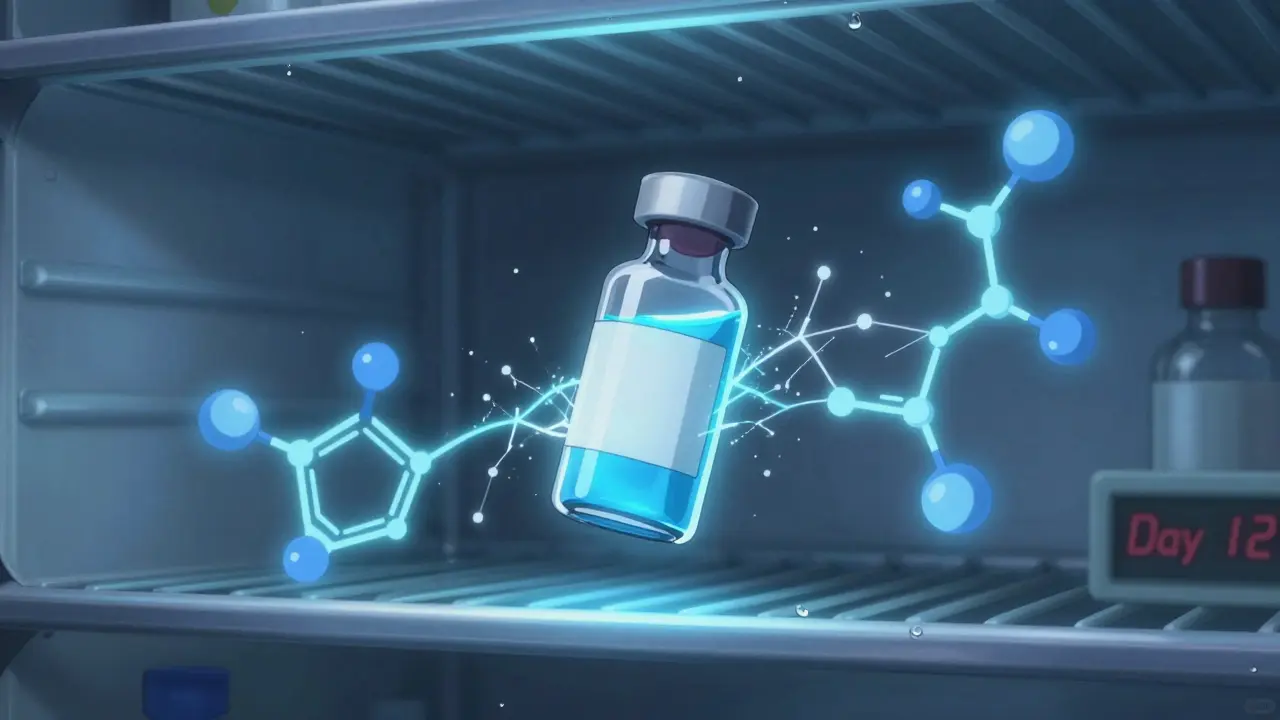
When you pick up your child’s antibiotic syrup from the pharmacy, it looks fresh. The bottle is clean, the label is clear, and the liquid is smooth. But here’s the catch: liquid antibiotics don’t last like pills. Once you mix them with water, the clock starts ticking - and it ticks fast. Most of these suspensions expire in just 7 to 14 days, even if you store them perfectly. And if you forget to refrigerate them? That window shrinks to 5 days or less.
Why Do Liquid Antibiotics Go Bad So Quickly?
It’s not about mold or contamination. It’s chemistry. Antibiotics like amoxicillin and ampicillin belong to a group called beta-lactams. These molecules are strong enough to kill bacteria - but only if they stay intact. Once you add water to the powder, the chemical structure begins to break down. Water triggers hydrolysis, a reaction that splits the antibiotic molecule into inactive pieces. The result? The medicine loses its power.
Studies show that even when stored correctly, amoxicillin drops to 90% potency after 14 days in the fridge. After that, it keeps degrading. Clavulanate, the add-on in amoxicillin/clavulanate (like Augmentin), is even more fragile. It starts breaking down in as little as 5 days at room temperature. That’s why your pharmacist tells you to toss it after 10 days - not because it’s unsafe, but because it’s no longer effective.
Temperature Is Everything
Storing liquid antibiotics at room temperature is the #1 mistake parents make. A 10°C rise in temperature can double the rate of degradation. That means if a bottle lasts 14 days in the fridge, it might only last 5 to 7 days on the kitchen counter.
Research from the American Journal of Hospital Pharmacy shows that freezing can extend shelf life dramatically. Amoxicillin kept at -20°C held 90% potency for 60 days. But freezing isn’t practical for most families. Thawing can change the texture, and not all formulations are designed for it. The FDA and USP guidelines don’t recommend freezing because it’s inconsistent and risky without proper lab controls.
What you can do is keep it cold. Always store reconstituted suspensions between 2°C and 8°C. That’s the back of the fridge, not the door. Every time you open the fridge, the temperature spikes. Keep the bottle tucked away, away from light, and never transfer it to a plastic syringe unless you’re using it right away - those can cut stability in half.
Amoxicillin vs. Amoxicillin/Clavulanate: The Big Difference
Not all liquid antibiotics are the same. Amoxicillin alone? It’s fairly stable. Most manufacturers say it lasts 14 days refrigerated. But when you add clavulanate - the part that fights resistant bacteria - everything changes.
Clavulanate is the weak link. Studies show it degrades faster than amoxicillin, especially in oral syringes. One study found that when clavulanate was stored in a syringe at 5°C, it lost potency in under 5 days. That’s why the discard date for Augmentin is 10 days, not 14. Pharmacists see this every day: parents get a 14-day prescription, but the medicine expires after 10. They’re forced to throw out unused doses - or worse, keep using it, hoping it still works.
This mismatch creates real problems. A 2023 Drugs.com survey found parents often stop treatment early because they run out of liquid before the infection clears. That’s not just inconvenient - it can lead to antibiotic resistance. The bacteria that survive become stronger, and next time, the same drug won’t work.
What Happens If You Use Expired Liquid Antibiotics?
It’s not dangerous like spoiled milk. You won’t get sick from taking old antibiotics. But you won’t get better either.
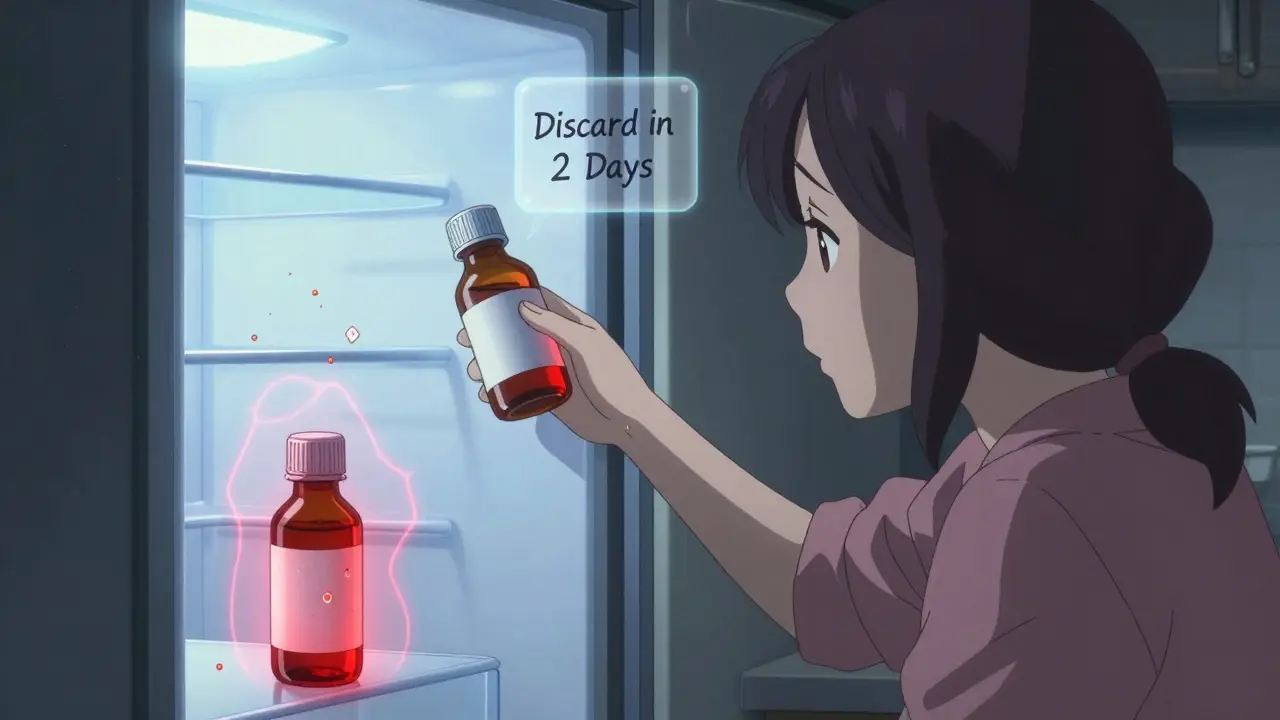
When potency drops below 90%, the dose isn’t enough to kill all the bacteria. Some survive. They multiply. And now you’ve trained them to resist the drug. This is how superbugs form. The CDC calls this one of the biggest threats to modern medicine.
Visual signs of degradation? Cloudiness, strange color (yellowish or brownish), or particles floating in the liquid. If you see any of that, toss it. But here’s the problem: degradation often happens without visible changes. The medicine can look fine and still be 40% weaker. That’s why dates matter more than looks.
Real-World Problems: When the Science Doesn’t Match Real Life
Pharmacists in Bristol, London, and Manchester report the same issue: patients forget the reconstitution date. One pharmacist told me about a mom who used a 17-day-old bottle because she thought, “It still looks fine.” The child’s ear infection came back - worse.
Another common problem? Prescriptions written for 10 days, but the bottle says “discard after 14.” Or the other way around: 14-day prescription, 10-day discard rule. That’s not a patient error - it’s a system flaw. Pharmacies don’t always label bottles clearly. Some don’t write the discard date at all.
And then there’s cost. A full bottle of amoxicillin/clavulanate can cost £20 to £30. Throwing out £10 worth of medicine hurts. So people stretch it. They don’t refrigerate. They leave it on the counter. They take it past the date. And then they wonder why the infection didn’t clear.
How to Get It Right: Simple Rules for Parents and Caregivers
- Write the discard date on the bottle the moment you get home. Use a permanent marker. Don’t rely on memory.
- Keep it in the fridge - not the door, not the shelf next to the milk. Back, bottom shelf, where it’s coldest.
- Don’t transfer to syringes unless you’re using it immediately. Syringes expose the liquid to air and plastic, speeding up breakdown.
- Check for changes - if it smells funny, looks cloudy, or has bits in it, throw it out.
- Ask your pharmacist - if the prescription is for 14 days but the bottle says 10, ask if they can split the dose or provide a second bottle.
Some pharmacies now offer reminder apps. CVS’s Script Sync sends text alerts when your antibiotic expires. That’s helped cut improper use by 18%. If your pharmacy doesn’t offer this, set a phone alarm for day 7 and day 10. Better safe than sorry.
What’s Changing? The Future of Liquid Antibiotics
Pharmaceutical companies know this is a problem. New formulations are coming. One 2021 study showed a microencapsulated version of amoxicillin/clavulanate lasted 21 days in the fridge. Another, Pfizer’s AmoxiClick system, uses a dual-chamber bottle that keeps powder and liquid separate until you press a button. It’s expected to launch in 2024 and could extend shelf life to 30 days.
But here’s the truth: beta-lactam antibiotics are inherently unstable in water. No matter how smart the packaging, the molecule will still break down. That’s why the 14-day rule exists. It’s not arbitrary. It’s science.
For now, the best solution is still the oldest one: use it fast, keep it cold, and never guess. Your child’s recovery depends on it.
Frequently Asked Questions
How long does liquid amoxicillin last after mixing?
Reconstituted amoxicillin lasts up to 14 days when stored in the refrigerator (2-8°C). At room temperature, it only lasts 5-7 days. Always check the label - some brands may say 10 days. When in doubt, ask your pharmacist.
Can I freeze liquid antibiotics to make them last longer?
Freezing can extend shelf life - studies show amoxicillin stays potent for 60 days at -20°C. But it’s not recommended for home use. Freezing and thawing can change the texture, make dosing inaccurate, and damage the formulation. Only do this if your pharmacist specifically advises it.
Is it dangerous to take expired liquid antibiotics?
It’s not toxic, but it’s ineffective. Expired antibiotics lose potency, meaning they won’t kill all the bacteria. This can lead to incomplete treatment, recurring infections, and antibiotic resistance. Never use medicine past its discard date.
Why does amoxicillin/clavulanate expire faster than plain amoxicillin?
Clavulanate, the component that fights resistant bacteria, is chemically unstable in water. It breaks down faster than amoxicillin - often within 5 days at room temperature. That’s why the discard date for amoxicillin/clavulanate is 10 days, even though amoxicillin alone lasts 14.
What should I do if my child’s prescription is for 14 days but the medicine expires in 10?
Call your pharmacist or doctor. They can split the prescription into two bottles - one for the first 10 days, another for the remaining 4. Some pharmacies will even provide a second bottle at no extra cost. Don’t try to stretch the medicine - it won’t work.


vivek kumar
January 17, 2026 AT 16:48