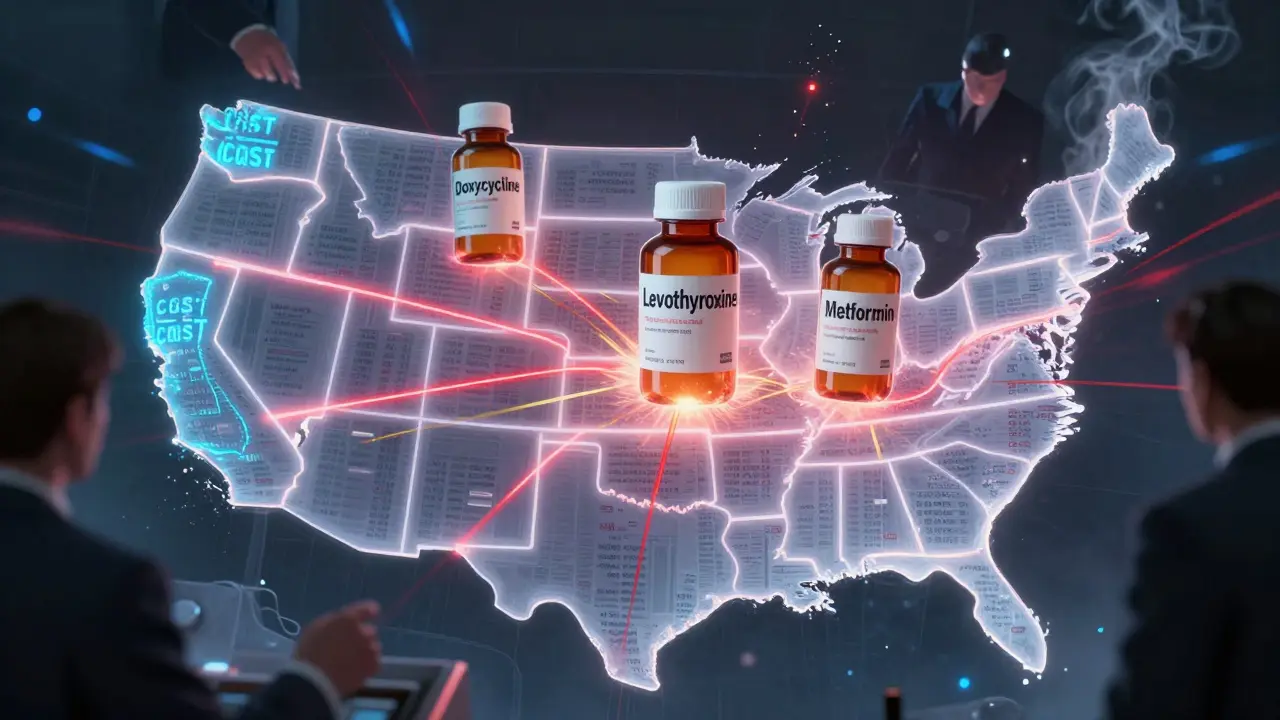
Medicaid spends billions on prescription drugs every year, but most of that money doesn’t go to brand-name pills. It goes to generic drugs. In 2023, generics made up 84.7% of all Medicaid prescriptions - yet only 15.9% of total drug spending. That’s the power of generics. But even with these low-cost alternatives, state Medicaid programs are under pressure. Drug prices still spike. Shortages happen. And manufacturers sometimes raise prices on old, off-patent drugs with no new research to justify it. So states are stepping in - not with broad bans, but with smart, targeted policies to keep generics affordable without cutting access.
How the Federal System Already Helps - And Where It Falls Short
The federal Medicaid Drug Rebate Program (MDRP) has been the backbone of generic drug pricing since 1990. Under this rule, drug makers must pay rebates to states in exchange for having their drugs covered by Medicaid. For generic drugs, the rebate is either 13% of the Average Manufacturer Price (AMP) or the difference between AMP and the "best price" the manufacturer offers anyone else - whichever is higher. That sounds solid. But here’s the catch: the formula doesn’t change even when a drug’s price jumps 500% overnight. Unlike brand-name drugs, states can’t negotiate extra rebates on generics. They’re stuck with what the federal formula gives them. That’s why states can’t rely on federal rules alone. When a generic drug like doxycycline or levothyroxine suddenly costs 10 times more, Medicaid has to act. And they are.Maximum Allowable Cost Lists: The Most Common State Tool
Forty-two states now use Maximum Allowable Cost (MAC) lists. These are price caps set by the state for each generic drug. If a pharmacy tries to bill Medicaid for a generic at $15, but the MAC is set at $10, Medicaid only pays $10. The pharmacy eats the difference - or finds a cheaper supplier. MAC lists aren’t just set and forgotten. Thirty-one states update them quarterly or more often. That’s critical because generic prices swing wildly. One month, a drug might cost $2.50. The next, after a manufacturer shuts down a plant, it spikes to $18. If the MAC isn’t updated fast enough, pharmacies get stuck paying more than Medicaid reimburses. A 2024 survey found that 68% of states update MAC lists monthly or less - meaning delays are common. That leads to claim denials, delayed payments, and angry pharmacists. Independent pharmacies reported that 74% of them had claims rejected or delayed because MAC lists didn’t match real market prices.Mandatory Generic Substitution: Getting the Right Drug at the Right Price
Forty-nine states require pharmacists to substitute a generic for a brand-name drug unless the prescriber says "do not substitute." That’s not new. But what’s changing is how states enforce it. Some now require pharmacies to use the lowest-cost generic available - even if it’s from a different manufacturer. Others are adding therapeutic interchange rules: if two generics treat the same condition, Medicaid will only pay for the cheaper one, unless the doctor explains why the more expensive one is needed. This isn’t about cutting corners. It’s about eliminating unnecessary price differences. Two identical 30-day supplies of metformin can cost $4 or $32 depending on the manufacturer. States are pushing for consistency.
Price Gouging Laws: Targeting Unfair Increases
In 2020, Maryland became the first state to pass a law specifically targeting price hikes on generic drugs. It allows the state to penalize manufacturers if they raise prices on off-patent drugs without new clinical data - and if the increase is deemed "unjustified." The law doesn’t cap prices. It just says: if you’re making a 500% profit on a 40-year-old drug, the state can step in. Since then, at least eight other states have introduced similar bills. California and Colorado are testing versions that let state health agencies investigate and demand justification before approving price hikes. The goal? To stop the practice of buying up old generic drugs just to jack up the price - a tactic known as "pharma arbitrage."Pharmacy Benefit Managers: The Hidden Middlemen
Thirty-three states hire Pharmacy Benefit Managers (PBMs) like OptumRx or Magellan to handle their pharmacy benefits. PBMs negotiate prices with drug makers, manage formularies, and pay pharmacies. But they also take a cut - sometimes hidden. In 2024, 27 states passed new rules requiring PBMs to disclose what they actually pay for generic drugs. Nineteen of those states now demand transparency on acquisition costs. Why? Because some PBMs were pocketing the difference between what they paid the manufacturer and what they billed Medicaid. A drug that cost $1.20 might be billed at $5. The state paid $5. The pharmacy got $1.20. The PBM kept $3.80. That’s not just wasteful - it’s fraud. States are now cracking down.Supply Chain Risks: The Silent Crisis
In 2023, 23 states reported shortages of critical generic drugs. Some lasted over 147 days. Insulin. Antibiotics. Blood pressure meds. These aren’t rare drugs. They’re essentials. And the problem is getting worse. Why? Because the generic drug market is concentrated. Three companies now control 65% of the generic injectables market. If one plant shuts down - for regulatory reasons, labor strikes, or natural disasters - supply chains break. States are responding. Twelve passed laws in 2024 to build strategic stockpiles of high-risk generics. Oregon and Washington launched a multi-state purchasing pool to buy 47 high-volume generics together, giving them more leverage. Texas is testing a gene therapy carve-out. New Hampshire created a risk pool to cover shortages. These aren’t flashy policies. But they’re saving lives.
What Doesn’t Work - And Why
Some states tried to force manufacturers to lower prices through direct negotiation. It didn’t go far. The federal rebate formula doesn’t allow it for generics. Others tried to cap prices at international levels - like Canada or the UK. Courts blocked those efforts. Drug makers sued, arguing they violated interstate commerce laws. The Congressional Budget Office warns that overly aggressive price controls could backfire. If manufacturers can’t make money on a generic drug, they stop making it. That’s when shortages get worse. And when a generic disappears, patients often switch to a more expensive brand-name drug - costing Medicaid even more.The Big Picture: Savings, Risks, and What’s Next
State efforts are working - but carefully. The CBO estimates that current state policies could cut generic drug spending by 5-8% annually. By 2027, that could add up to $3.8 billion in savings. But the same report warns: if policies are too harsh, Medicaid could end up paying 2.3% more overall because patients switch to pricier alternatives. The real win? Stability. States are moving from reacting to price spikes to planning for them. They’re building stockpiles. They’re forcing transparency. They’re holding manufacturers accountable. And they’re doing it without shutting down access. Looking ahead, 15 more states are expected to introduce generic drug pricing legislation in 2025. The focus? Supply chain resilience, PBM oversight, and targeted rebates during shortages. The federal government is stepping back. Medicaid is now the frontline in the fight to keep generic drugs affordable.What This Means for Patients
You might not see these policies on your prescription label. But they’re why your $4 metformin still costs $4 - even when inflation hits everything else. They’re why your state Medicaid program didn’t suddenly stop covering your blood pressure med. And they’re why your pharmacist can still get you the drug you need, even when supply chains are stretched thin. These aren’t theoretical fixes. They’re real, working tools - imperfect, but necessary. States are learning fast. And they’re not waiting for Washington to act.How do state Medicaid programs control generic drug prices?
States use tools like Maximum Allowable Cost (MAC) lists to set price caps on generics, require pharmacists to substitute lower-cost generics, enforce price gouging laws on unjustified hikes, and demand transparency from Pharmacy Benefit Managers (PBMs). Some also build strategic stockpiles to prevent shortages.
Why can’t Medicaid just negotiate lower prices for generics like Medicare does?
Medicaid is bound by the federal Medicaid Drug Rebate Program (MDRP), which uses a fixed formula for rebates on generics - not negotiation. Unlike Medicare Part D, Medicaid states can’t negotiate supplemental rebates for generic drugs. That limits their flexibility, so they use other tools like MAC lists and anti-gouging laws instead.
Are generic drug shortages getting worse?
Yes. In 2023, 23 states reported shortages of critical generic drugs, with some lasting over 147 days. The main causes are manufacturing consolidation - three companies control 65% of injectable generics - and supply chain fragility. States are now creating stockpiles and multi-state purchasing pools to reduce risk.
Do MAC lists hurt pharmacies?
They can. If MAC lists aren’t updated quickly when generic prices drop, pharmacies get paid less than they paid for the drug - leading to losses. If prices rise above the MAC, pharmacies may not get reimbursed at all. A 2024 survey found 74% of independent pharmacies faced delayed payments or claim rejections due to outdated MAC lists.
What’s the biggest threat to state generic drug policies?
The biggest threat is unintended consequences. If price controls are too strict, manufacturers may stop making low-margin generics, causing shortages. Then patients switch to more expensive brand-name drugs - costing Medicaid more overall. The goal is balance: savings without sacrifice.


mukesh matav
December 20, 2025 AT 20:09