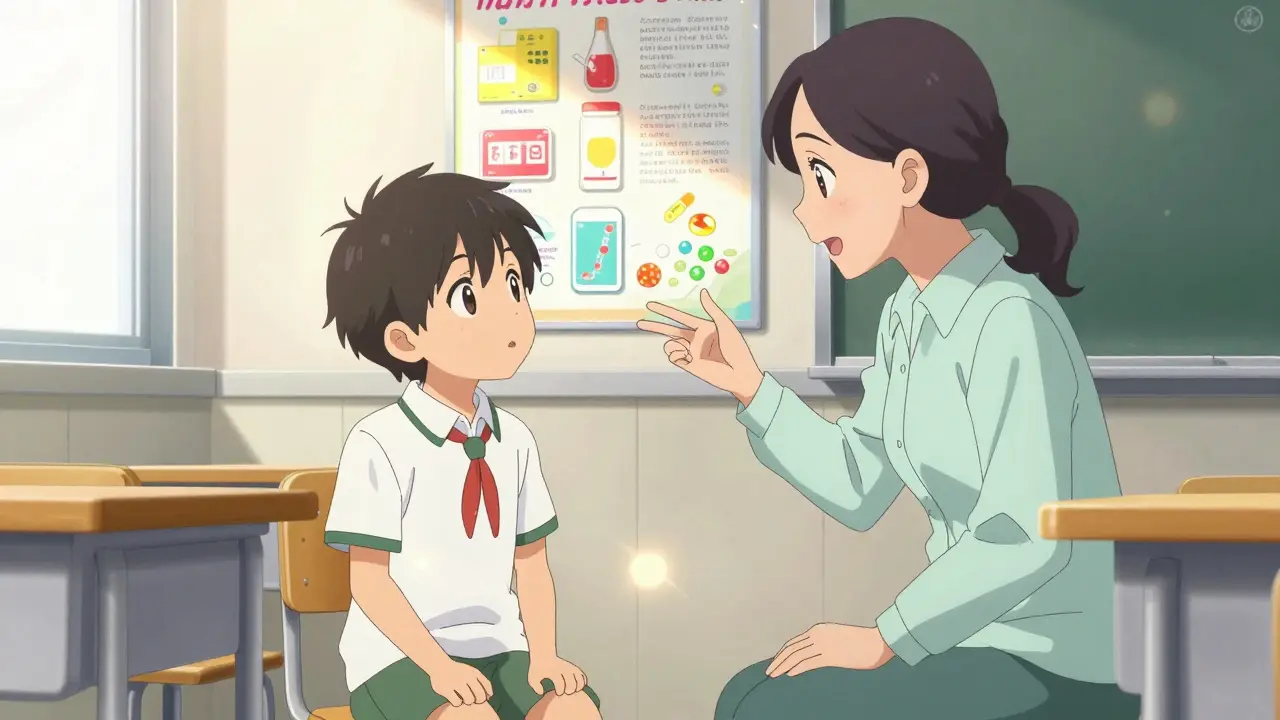
Talking to kids about medicine can feel like a minefield. You want them to understand that some pills save lives while others are dangerous, but you don't want to scare them so much that they stop trusting you. The real challenge isn't just telling them "don't touch that," but giving them the critical thinking skills to handle a world where medicines are everywhere-from the kitchen cabinet to social media trends. Whether you're a parent or an educator, the goal is to move away from fear-based warnings and toward pediatric drug education that actually sticks.
The Shift from Scare Tactics to Real Skills
For decades, the go-to method for drug education was the "just say no" approach. Programs like the early versions of DARE tried to frighten kids into abstinence. However, the data shows this often backfired. A 2019 study by the RAND Corporation found that scare tactics actually increased curiosity about drugs by 18%. When we tell kids a substance is "forbidden fruit," it often becomes more attractive.
Modern, evidence-based approaches do things differently. Instead of focusing on the "horror story," they focus on skill-building. This means teaching Refusal Skills the ability to decline peer pressure using assertive communication and social strategies. According to NIDA, students who practice these specific refusal techniques are 30% more resistant to peer pressure than those who just receive general warnings.
Teaching Medication Safety by Age Group
You can't explain pharmacology to a five-year-old the same way you would to a fifteen-year-old. The content needs to evolve as the child's brain develops. Effective programs break this down into three distinct stages.
Elementary School (K-5): The Safety Basics
At this age, the focus is on "medication safety." The priority is preventing accidental poisoning and teaching kids that medicine is not candy. Programs like Generation Rx an evidence-based educational initiative providing free medication safety resources for students and educators use tools like the "Medication Safety Patrol" to make learning interactive. For kids in grades K-2, the lesson is simple: never take anything unless it comes from a trusted adult. By grades 3-5, the focus shifts to understanding the difference between prescription and over-the-counter medicines.
Middle School (6-8): Navigating Social Pressure
Middle school is where the social dynamic changes. This is the prime time for role-playing scenarios. Rather than a lecture, students engage in simulations where they practice saying no without sounding "uncool." The National Institute on Drug Abuse a leading federal agency focused on drug misuse and addiction research and education (NIDA) provides curricula that teach the science of addiction, explaining how the brain changes during adolescence, which makes the risk of substance use higher for them than for adults.
High School (9-12): Critical Thinking and Ethics
Teens need honesty. They can spot a lie or an exaggeration from a mile away. Programs like "Safety First" by the Drug Policy Alliance use a transparent approach. Instead of claiming drugs are completely unheard of, they emphasize that while many teens don't use them, the risks for those who do are real. Research from the University of Maryland shows that messaging emphasizing the fact that "most teens actually don't use drugs" reduces initiation rates by 22% because it aligns with the statistical reality.
| Approach | Core Strategy | Impact on Retention | Risk Factor |
|---|---|---|---|
| Interactive/Skill-Based | Role-playing & critical thinking | 25-35% Higher | Requires trained facilitators |
| Fear-Based/Scare Tactics | Warning of extreme outcomes | Lower | Increases curiosity (18%) |
| Abstinence-Only | Zero-tolerance messaging | Moderate to Low | Creates cynicism in teens |

The Danger of the "Recovering Addict" Narrative
It seems logical to bring in a guest speaker who has struggled with addiction to tell their story. However, educators should be cautious. Research from the Australian National University found that these presentations can inadvertently normalize drug use. When a speaker describes their life in a way that seems common or a "rite of passage," some students may actually see drug use as a more normal part of growing up, which increased experimentation rates by 12% in some studied groups.
The most effective way to prevent misuse is to integrate drug education with Social-Emotional Learning a process where children and adults acquire and apply knowledge, skills, and attitudes to develop healthy identities and manage emotions (SEL). When kids know how to manage stress, anxiety, and loneliness, they are far less likely to look for an escape through substances.
Dealing with Modern Threats: Fentanyl and Social Media
The landscape of drug safety has changed drastically in the last few years. We are no longer just talking about a pill in a cabinet; we're talking about synthetic opioids and "TikTok challenges." Since 2019, adolescent deaths involving fentanyl have increased by 1,200%. This requires a specific, urgent type of education.
Children need to understand that in the modern market, a pill bought from a peer or a social media contact may not be what it claims to be. The "Medication Safety in the Digital Age" module addresses how social media promotes drug challenges, which have seen a 300% increase among youth. Teaching kids to question the source of information they see online is now just as important as teaching them not to touch a stranger's medicine.

Practical Tips for Parents and Teachers
If you're implementing these conversations at home or in a classroom, keep these rules of thumb in mind:
- Avoid the "Lecture" Mode: Ask open-ended questions. Instead of "Do you know drugs are bad?", try "What have you heard about vaping at school?"
- Be Specific: Instead of saying "medicine can be dangerous," say "taking someone else's blood pressure medication could make your heart beat too slowly."
- Stay Current: Use resources from NIDA or Generation Rx. Drug trends change faster than textbooks can be printed.
- Build Trust First: Ensure your child knows they can come to you if they make a mistake or find something they shouldn't have, without the immediate fear of an explosion of anger.
At what age should I start talking to my child about drug safety?
Start as soon as they are curious about the world around them, typically in preschool or kindergarten. At this early stage, the focus should be entirely on basic safety: only taking medicine from a parent or trusted caregiver and understanding that medicine is not candy.
Are free resources actually effective compared to paid programs?
Yes. Many of the most effective programs, such as those provided by NIDA and Generation Rx, are free. Effectiveness depends on the methodology (interactive vs. passive) and the training of the educator, not the price tag of the curriculum.
How do I handle a child's curiosity after they've learned about drugs in school?
Use their curiosity as a bridge to deeper conversation. Ask them what they found interesting or confusing about the lesson. This allows you to correct misconceptions and reinforce the critical thinking skills they are learning in class.
What is the most dangerous mistake parents make in drug education?
Using extreme fear or exaggeration. When children find out that the "scary" stories they were told aren't entirely true, they may stop believing any warnings you give them, even the ones about genuinely lethal substances like fentanyl.
How can I tell if a drug prevention program is "evidence-based"?
Look for six key characteristics: interactive delivery, multiple structured sessions over weeks (not a one-off assembly), trained facilitators, a focus on skill development (like refusal skills), accurate risk information, and planned booster sessions in later years.
Next Steps for Implementation
For educators, the first step is a gap analysis. Use a pre-assessment quiz to find out what your students actually know and where their misconceptions lie. If you are a parent, start by auditing your own home-ensure all medications are stored securely and that you have a plan for how to discuss emerging trends like vaping or social media challenges.
If you're looking for a starting point, the Generation Rx toolkits offer a great way to introduce these topics without feeling like you're delivering a formal lecture. The key is consistency; a five-minute conversation every few months is far more effective than one giant, stressful talk once a year.


Arthur Luke
April 18, 2026 AT 23:53