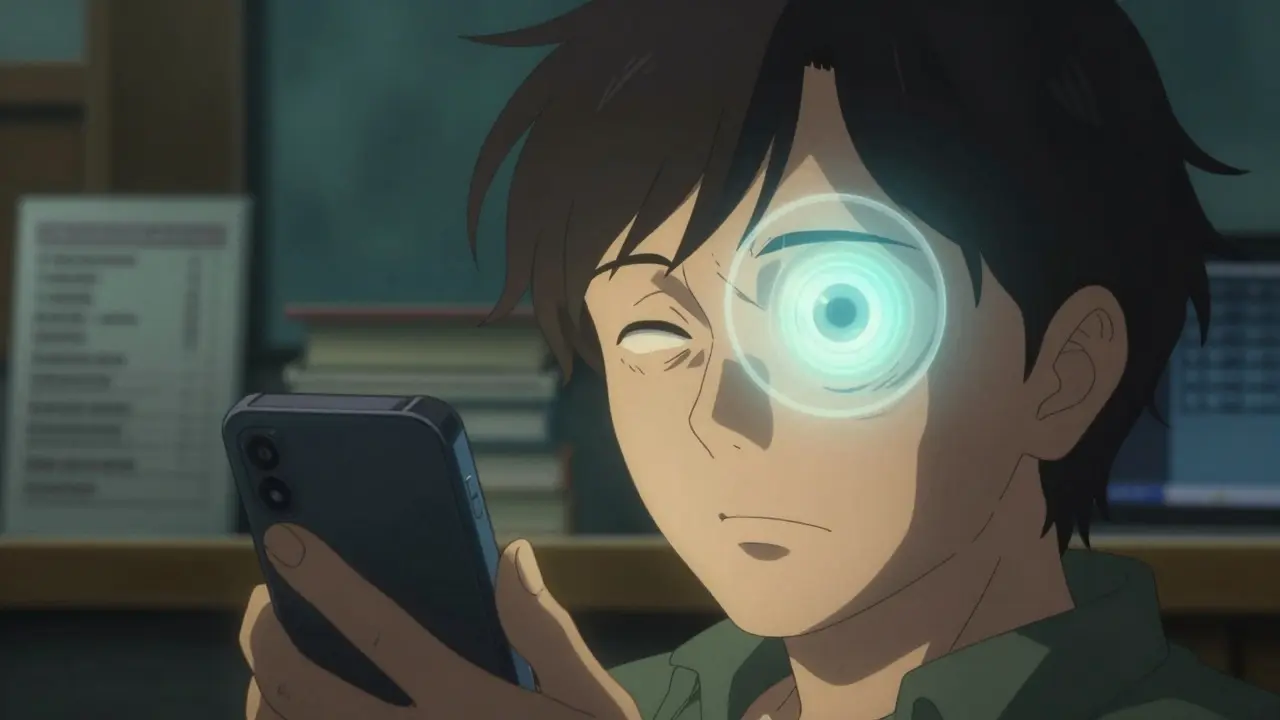
By your mid-40s, you might start holding your phone farther away to read a text. Or you’re squinting at the menu at dinner, then realizing you need to move it back and forth to find the sweet spot. This isn’t just bad lighting. It’s not stress. It’s not even laziness. It’s presbyopia - and it’s happening to everyone. No exceptions. If you live long enough, you will get it. It’s as natural as gray hair or wrinkles. The only difference? You can fix it - easily, affordably, and without surgery.
What Exactly Is Presbyopia?
Presbyopia isn’t a disease. It’s not something you caught or caused. It’s the result of your eye’s natural lens getting stiffer over time. When you’re young, your lens is soft and flexible, like a rubber band. It changes shape instantly to focus on things close up - your phone, a book, a needle. But as you age, layers build up on the lens, like rings in a tree. It thickens. It hardens. And it loses its ability to bend light properly for near vision. This isn’t the same as farsightedness. Farsightedness is about the shape of your eyeball. Presbyopia is about the lens. And here’s the key: every single person on Earth gets it. The National Eye Institute confirms it. By age 45, nearly everyone starts noticing trouble with close-up tasks. By 60, your lens can barely change shape at all. The focusing power drops from 14 diopters at age 10 to just 0.5 diopters by age 60. That’s why your near point - the closest distance your eye can focus - moves from 7 cm to over 100 cm. You literally can’t bring things close enough to see them clearly anymore.How Do You Know You Have It?
The signs are simple and unmistakable:- You hold reading material farther away to make it clearer
- Small print on labels, menus, or phone screens looks blurry
- Your eyes tire quickly when reading or doing close work
- You need brighter light to see fine details
- You get headaches after prolonged reading or screen time
Reading Glasses: The Simple Fix
The easiest, cheapest, and most common solution? Reading glasses. Over-the-counter readers cost between $6 and $20 at Walmart, CVS, or Amazon. They come in +0.75 to +3.50 diopter strengths, in 0.25 increments. Most people start with +1.00 to +1.50 at age 45. By 65, many need +2.50 to +3.00. You don’t need a prescription. You don’t need an eye exam. Just try a few pairs. Stand at arm’s length from your phone. Pick up a pair. If the text is clear, you’ve got the right strength. If it’s still blurry, go one step stronger. If it’s too sharp or gives you a headache, go one step weaker. But here’s the catch: 35% of people pick the wrong strength, according to Optometry Times. Too weak? You’ll strain your eyes. Too strong? You’ll get headaches and dizziness. And they’re only good for close-up work. Take them off to drive, watch TV, or look across the room. That’s why many people end up with two pairs - one for reading, one for computer use.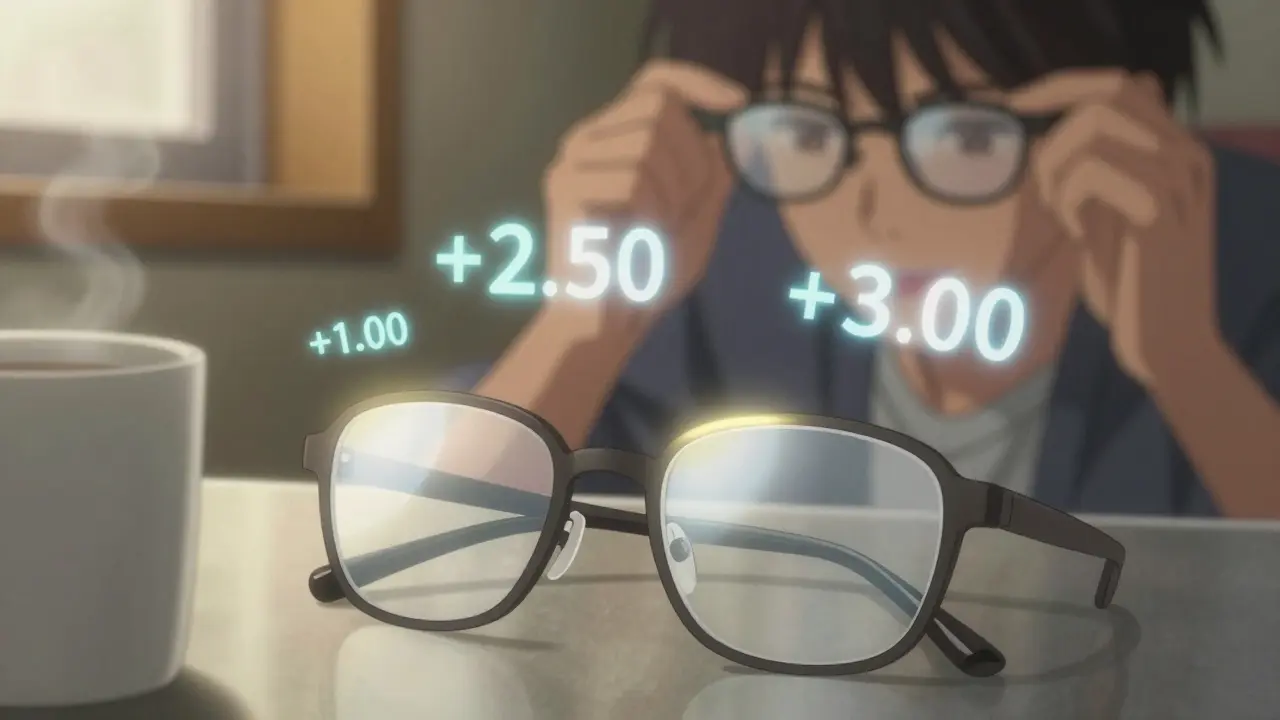
Progressive Lenses: The Seamless Alternative
If you already wear glasses for distance vision, reading glasses aren’t practical. You’re constantly switching between two pairs. That’s where progressive lenses come in. These are single lenses with three zones: top for distance, middle for computer distance, bottom for reading. No lines. No visible segments. Just smooth transitions. They cost $250-$450, depending on brand and material. But they require an adaptation period. Goodeyes.com reports most people need 2-4 weeks to adjust. Your brain has to learn to move your head - not your eyes - to find the right focus zone. Some people get dizzy or feel like they’re walking on a slope. Peripheral distortion affects about 25% of first-time wearers. That’s why some retailers now offer “progressive trial kits” - low-cost pairs to test before committing. The newer models, like EssilorLuxottica’s Eyezen Progressive 2.0 (launched March 2023), have wider near zones and better peripheral clarity based on data from 10,000 wearers. Still, Dr. George Witkin of NYU Langone says even the best progressives leave 15-20% distortion. Only 60% of users achieve perfect near vision without compromise.Bifocals, Contacts, and Surgery: Other Options
Bifocals are the older version of progressives - with a visible line separating distance and near. They cost $200-$350 and are easier to adapt to than progressives, but the line can be annoying. Some people hate the way they look. Monovision contact lenses correct one eye for distance and the other for near. About 80% of people adapt successfully. But 15% lose depth perception. That’s a problem if you drive at night, play sports, or work with fine tools. Surgery is the permanent fix - but it’s not risk-free.- Conductive Keratoplasty (CK): Uses radio waves to reshape the cornea. Gives about +2.5 diopters of near vision. Temporary effect - fades over 1-2 years.
- LASIK Monovision: One eye is corrected for distance, the other for near. 85% satisfaction rate, but 35% develop dry eyes. 10-15% need retreatment within five years.
- Refractive Lens Exchange: Your natural lens is replaced with a multifocal implant. Costs $3,500-$5,000 per eye. Works like cataract surgery. Gives permanent results but can cause halos at night (25% of users) and reduced contrast sensitivity (15%).
- Corneal Inlays: Like Presbia’s Flexivue Microlens (approved in Europe in 2022). A tiny lens is inserted into the cornea. 78% of patients reach 20/25 near vision after a year. Still not FDA-approved in the U.S. as of 2026.
What Doesn’t Work
There are a lot of claims out there: eye exercises, blue light glasses, omega-3 supplements, vision training apps. None of them prevent or reverse presbyopia. The National Eye Institute’s Dr. Emily Chew says it plainly: “No amount of eye exercises or dietary changes can prevent presbyopia - it’s as inevitable as gray hair.” Your lens hardens because of biology, not lifestyle. You can’t strengthen it with yoga. You can’t soften it with vitamins. The aging process is physical. It’s structural. And it’s universal.When to See an Eye Doctor
The American Academy of Ophthalmology recommends a full eye exam at age 40 - even if you think your vision is fine. Why? Because presbyopia often hides other problems. Glaucoma, macular degeneration, and diabetic retinopathy can start without symptoms. A comprehensive exam includes cycloplegic refraction - drops that relax the eye muscles to get the true reading. Without it, your prescription can be off by 0.25 to 0.50 diopters. That’s enough to cause daily strain. Also, if you’re thinking about surgery or progressives, you need precise measurements: pupillary distance (within 0.5mm), frame wrap angle, and vertex distance. These aren’t guesswork. They’re science. And they make the difference between comfort and headaches.The Bottom Line
Presbyopia is inevitable. It’s not a flaw. It’s a sign you’re aging - and that’s okay. You don’t need to panic. You don’t need to spend hundreds of dollars. You don’t need surgery unless you want to. Start with reading glasses. Try a few strengths. Find what works. If you already wear distance glasses, ask about progressives. Don’t rush the adaptation. Give yourself a month. If you’re still struggling, talk to an optometrist. Don’t trust online quizzes. Don’t rely on Amazon reviews alone. Your eyes are unique. The global market for presbyopia correction is growing fast - 1.8 billion people now, 2.1 billion by 2030. But the simplest solution remains the most effective: a $10 pair of readers. You don’t need a miracle. You just need to see clearly - and that’s possible, today, without a single surgery.Is presbyopia the same as farsightedness?
No. Farsightedness (hyperopia) is caused by the shape of the eyeball being too short, which makes it hard to focus on close objects even when young. Presbyopia is caused by the lens stiffening with age. You can be farsighted and get presbyopia, but they’re different conditions. One is structural; the other is biological aging.
Can I use reading glasses all day?
No. Reading glasses only correct near vision. If you wear them to drive, watch TV, or look across the room, everything will look blurry. They’re meant for short tasks like reading, sewing, or using your phone. If you need clear vision at all distances, you need progressives, bifocals, or multifocal contacts.
Why do my reading glasses give me headaches?
Headaches usually mean the power is too strong. If your glasses are too powerful, your eyes have to work harder to focus, which causes strain. It can also happen if you’re using cheap lenses with poor optical quality - they distort light and create visual fatigue. Try a lower strength or upgrade to a better brand. If headaches continue, get a professional eye exam.
Do I need an eye exam to buy reading glasses?
No, you don’t need one to buy over-the-counter readers. But you should get an exam every two years after age 40 - not just for presbyopia, but to catch glaucoma, cataracts, or macular degeneration early. These conditions don’t hurt and don’t show symptoms until it’s too late. An exam also ensures you’re not masking another problem with the wrong glasses.
Are progressive lenses worth the cost?
If you already wear distance glasses and need to switch between reading and looking far away often - like when driving, working on a computer, or walking around - yes. They eliminate the need to carry two pairs. But they’re not perfect. The adaptation period is real, and peripheral distortion affects many users. Try a low-cost trial pair first. If you’re active and hate the idea of switching glasses, they’re a solid investment.
Can eye exercises cure presbyopia?
No. The lens hardens due to biological aging - adding layers like an onion. No amount of rolling your eyes, focusing on distant objects, or doing “eye yoga” can reverse this. The National Eye Institute confirms this. These exercises may reduce eye strain temporarily, but they won’t restore lost focusing power. Don’t waste money on programs that promise to reverse presbyopia.


Aaron Pace
March 8, 2026 AT 06:53