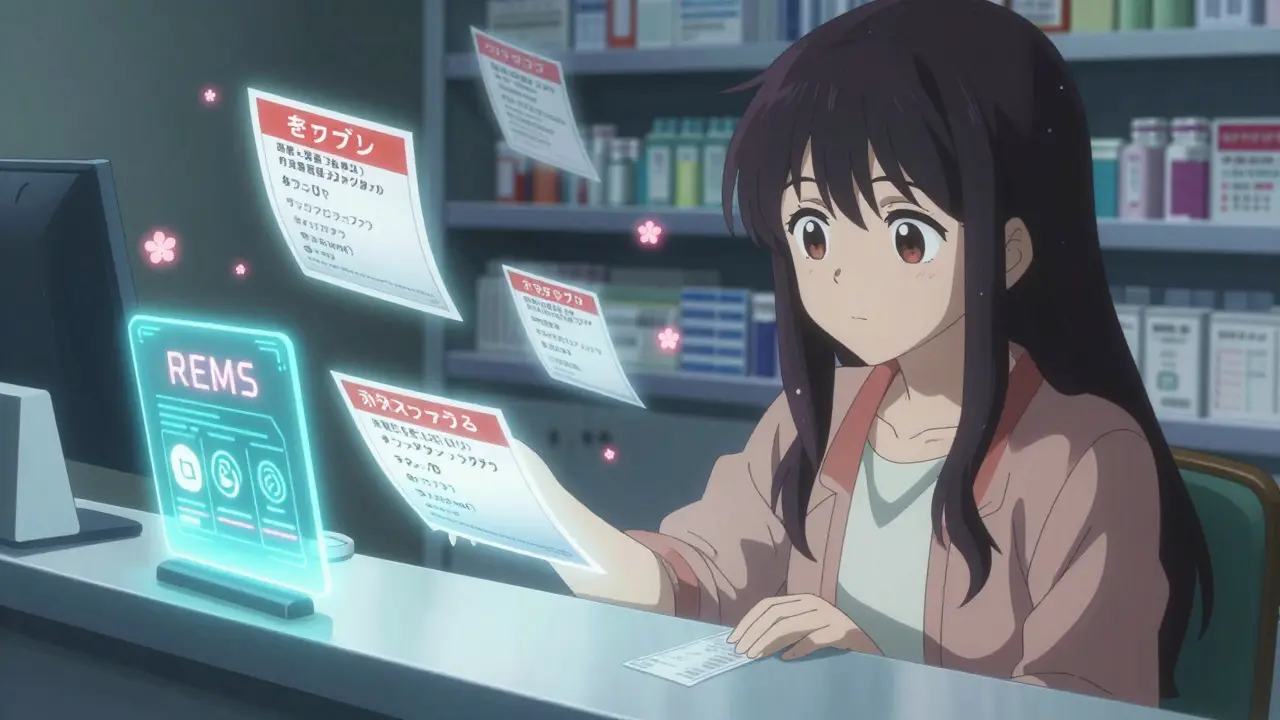
When a drug can save your life but also carry a serious risk-like causing birth defects, sudden heart failure, or dangerous brain reactions-how do you make sure it’s used safely? That’s where REMS programs come in. These aren’t just extra warnings on a pill bottle. They’re official, legally required safety systems put in place by the U.S. Food and Drug Administration (FDA) to manage high-risk medications. If you’ve ever waited days to get a prescription filled, or had your doctor jump through hoops to approve a treatment, you’ve likely run into a REMS program.
What Exactly Is a REMS Program?
REMS stands for Risk Evaluation and Mitigation Strategies. It’s a formal framework created by the FDA in 2007 under the Food and Drug Administration Amendments Act (FDAAA). The goal isn’t to block dangerous drugs-it’s to let life-saving medications reach patients while reducing the chance of serious harm. Think of it like a safety net with specific rules: if a drug has a known, serious side effect that can’t be fully controlled by standard labels or warnings, the FDA can require a REMS program to manage it. Not every drug needs this. About 95% of FDA-approved medications are considered safe enough with regular prescribing guidelines and package inserts. But for the remaining 5%, the risks are too high to ignore. That’s where REMS kicks in. Drugs like isotretinoin (for severe acne), clozapine (for treatment-resistant schizophrenia), and thalidomide (for leprosy and multiple myeloma) are all under REMS because their side effects can be life-altering-or even fatal-if not carefully managed.How REMS Programs Work: The Key Pieces
Each REMS program is custom-built for the specific drug and its risks. There’s no one-size-fits-all approach. The FDA uses three main tools to control risk:- Medication Guides: These are printed handouts given to patients when they pick up their prescription. They explain the risks in plain language-no medical jargon. For example, a guide for isotretinoin clearly states: “You must not get pregnant while taking this drug.”
- Communication Plans: These are training materials and alerts sent to doctors, pharmacists, and nurses. They make sure the people prescribing and dispensing the drug know exactly what to watch for. For drugs like Zyprexa Relprevv, providers are told to monitor patients for at least three hours after each injection because of the risk of sudden sedation or delirium.
- Elements to Assure Safe Use (ETASU): This is the strictest layer. It can include requirements like:
- Doctors must be certified to prescribe the drug
- Patients must enroll in a national registry
- Medications can only be dispensed at special pharmacies or clinics
- Patients need regular blood tests or lab checks
Take clozapine, for example. It’s one of the most effective treatments for severe schizophrenia, but it can wipe out white blood cells, leaving patients vulnerable to deadly infections. Under its REMS program, patients must get weekly blood tests for the first six months. Pharmacists can’t fill the prescription unless the lab results are uploaded to the REMS system and approved. That’s not just paperwork-it’s a lifesaving checkpoint.
Who Runs These Programs?
The FDA sets the rules, but the drug companies pay for and run the programs. That means pharmaceutical manufacturers are responsible for building the online portals, training systems, registries, and tracking tools. They also have to prove to the FDA that the program is working. This setup has pros and cons. On one hand, the companies know their drugs best and can design systems that fit the clinical workflow. On the other hand, it creates a patchwork of different systems. One drug might use a simple web form. Another might need a full patient portal with two-factor authentication. Many doctors and pharmacists report juggling five or six different REMS platforms for just a few medications.
Why REMS Can Cause Delays
If you’ve ever waited a week to start a new medication, you’re not alone. A 2019 study in JAMA Internal Medicine found that REMS drugs take an average of 5.4 days longer to get filled than non-REMS drugs. For patients with rare diseases, delays can be even worse. Here’s why:- Doctors have to complete training-usually 1 to 2 hours-before they can prescribe.
- Pharmacists must verify patient eligibility through secure portals, which can take 15 to 20 minutes per prescription.
- Some programs require patients to be enrolled in a registry before the first fill, which can take days to process.
- Many REMS systems don’t connect to electronic health records. That means staff have to manually copy and paste data, increasing errors and delays.
A 2022 survey by the American Medical Association found that 68% of physicians reported delays in starting REMS medications. Forty-two percent said those delays hurt patient outcomes-like someone with epilepsy missing doses and having a seizure, or a cancer patient waiting too long for treatment.
Pharmacists feel it too. A 2023 survey by Pharmacy Times showed 73% of hospital pharmacists spend 2 to 5 extra hours per week just managing REMS requirements. On Reddit, pharmacy students and professionals regularly post about the “iPLEDGE” system for isotretinoin-where patients need multiple pregnancy tests, counseling sessions, and online verifications before they can get their monthly supply. One user wrote: “I had a 17-year-old girl crying because she couldn’t get her acne meds for a week because her mom forgot to log into the portal.”
Who Benefits from REMS?
Despite the headaches, REMS programs have saved lives. Dr. Robert Temple, a former top FDA official, says REMS made it possible to approve drugs that would’ve been too risky otherwise. Thalidomide, once infamous for causing birth defects in the 1960s, is now used to treat certain cancers and leprosy-because of strict REMS controls. Patients with rare diseases rely on REMS to access treatments that might not exist without them. Drugs for conditions like amyloidosis or severe autoimmune disorders often have serious side effects. Without REMS, many wouldn’t be approved at all. But the system isn’t perfect. In 2023, the FDA approved the first-ever “sunset” of a REMS program-for thalidomide-after 20 years. Why? Because better education, alternative treatments, and improved monitoring made the original restrictions unnecessary. That’s progress.
What’s Changing in 2026?
The FDA knows REMS can be burdensome. That’s why they’re making changes:- Standardization: Since 2023, 22 of the 78 active REMS programs have been moved to a single digital platform to reduce confusion and paperwork.
- Digital tools: Pilot programs are testing smartphone apps that let patients log side effects in real time. One trial is using wearable patches to monitor heart rhythm in patients on high-risk blood thinners.
- Access focus: New REMS proposals now require sponsors to prove the program won’t block care for rural, low-income, or elderly patients.
- Measuring success: Right now, 63% of REMS programs don’t have clear metrics to show if they’re actually improving safety. The FDA is now requiring that.
By 2027, experts predict nearly half of all new cancer drugs will need REMS. That’s because targeted therapies are more powerful-but also more toxic. The challenge isn’t just controlling risk. It’s doing it without making treatment impossible to get.
What Patients Should Do
If your doctor prescribes a drug with a REMS program:- Ask: “Is this under a REMS program?”
- Ask: “What do I need to do to get it?”
- Ask: “Do I need to register somewhere? Will my pharmacy need to verify anything?”
- Keep copies of all required documents-lab results, consent forms, training confirmations.
- If you’re delayed, call your doctor’s office. Sometimes they can help speed up the process.
Don’t assume it’s just another bureaucracy. REMS isn’t meant to frustrate you. It’s meant to protect you. But you need to be part of the process.
What Providers Should Know
For doctors and pharmacists:- Stay updated. REMS requirements change. Check the FDA’s REMS Dashboard regularly.
- Use the new centralized platform where possible-it’s faster.
- Advocate for your patients. If a REMS requirement is causing harm through delay, report it to the FDA.
- Know which drugs in your practice are under REMS. Oncology, neurology, and immunology drugs are the most common.
There’s no excuse for ignorance anymore. The FDA provides free training modules, templates, and webinars. Use them.
What drugs are covered by REMS programs?
As of 2026, the FDA lists 78 active REMS programs covering about 150 medications. The most common are in oncology (29 programs), neurology (14), and immunology (11). Examples include clozapine, isotretinoin, thalidomide, Zyprexa Relprevv, and certain opioid painkillers. The full list is updated monthly on the FDA’s REMS Dashboard.
Do REMS programs apply to generic drugs too?
Yes. Once a brand-name drug has a REMS, generic versions of that same drug must follow the same rules. For example, if the brand-name clozapine has a REMS, every generic clozapine must use the same patient registry, blood test requirements, and pharmacy verification system. This ensures safety doesn’t depend on which version you get.
Can a REMS program be removed?
Yes. The FDA can remove or modify a REMS if new data shows the risks are better controlled through other means. In August 2023, the thalidomide REMS was officially ended after 20 years because improved education and alternative treatments made the strictest requirements unnecessary. This is rare, but it shows the system can evolve.
How much do REMS programs cost?
Pharmaceutical companies spend an estimated $1.2 billion per year on REMS programs. Simple programs-like just printing medication guides-cost around $500,000 a year. Complex ones with patient registries, certified providers, and special dispensing can cost over $15 million annually. These costs are built into drug prices, which is why REMS drugs are often more expensive.
Is there a way to check if my medication has a REMS program?
Yes. The FDA publishes a public REMS Dashboard that lists all active programs with details on requirements. You can also ask your pharmacist or check the drug’s prescribing information on the FDA website. If the drug has a REMS, the label will say “REMS: Required” and list the program name.


Robin Van Emous
January 27, 2026 AT 19:12