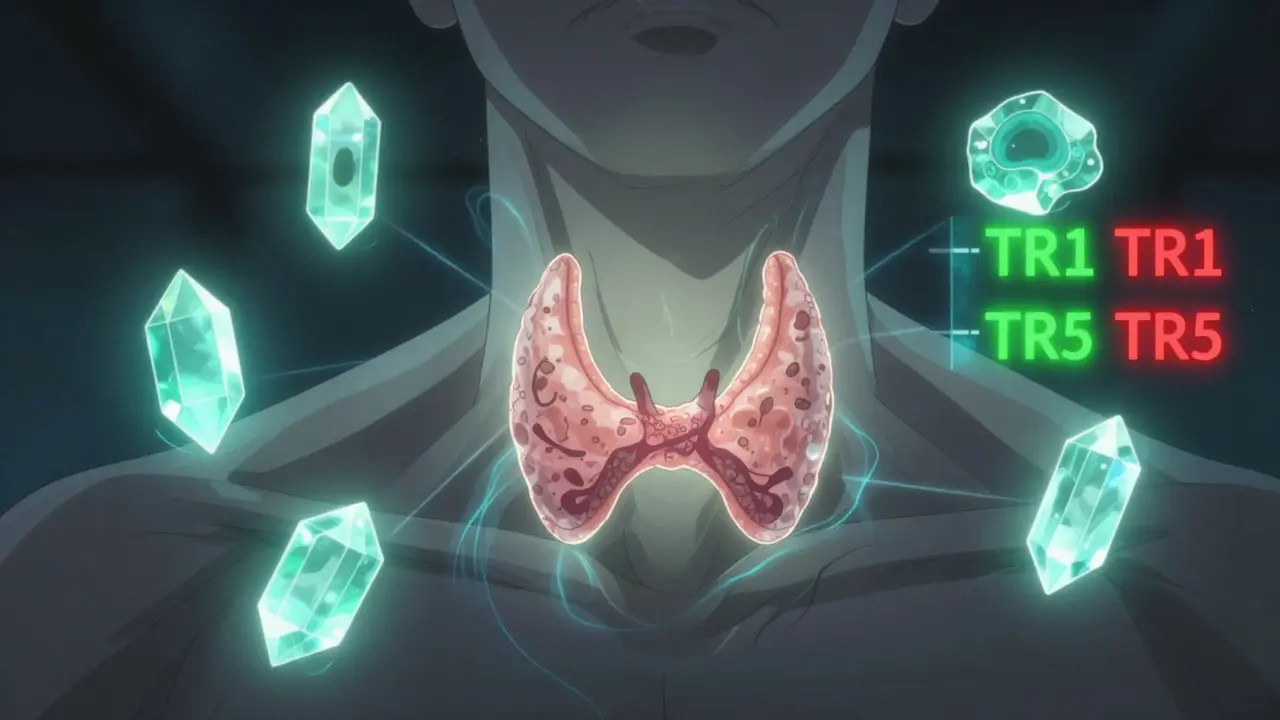
When a doctor finds a lump in your neck, the first test isn’t a biopsy-it’s an ultrasound. That’s because thyroid ultrasound is the most accurate, safe, and widely used way to check for nodules and estimate cancer risk without cutting into your skin. Unlike CT scans or MRIs, it uses sound waves, not radiation. Unlike blood tests, it shows you exactly what’s inside the gland. And unlike physical exams, which miss most nodules, ultrasound finds them in nearly 7 out of 10 people-often before they cause symptoms.
What Thyroid Ultrasound Actually Shows
Thyroid ultrasound doesn’t just show a blob. It reveals five key features that tell doctors whether a nodule might be cancerous. These aren’t guesses-they’re measurable traits backed by decades of research.
- Composition: Is the nodule mostly fluid (cystic), full of tiny holes (spongiform), or solid? Solid nodules carry more risk.
- Echogenicity: How bright or dark does it look compared to the surrounding tissue? Markedly hypoechoic (very dark) nodules are more likely to be cancerous.
- Shape: Is it wider than it is tall, or taller than it is wide? Taller-than-wide nodules raise red flags.
- Margin: Are the edges smooth, jagged, or spreading outside the thyroid? Ill-defined or irregular borders increase suspicion.
- Punctate echogenic foci: Tiny white dots inside the nodule-these are microcalcifications. They’re one of the strongest predictors of cancer.
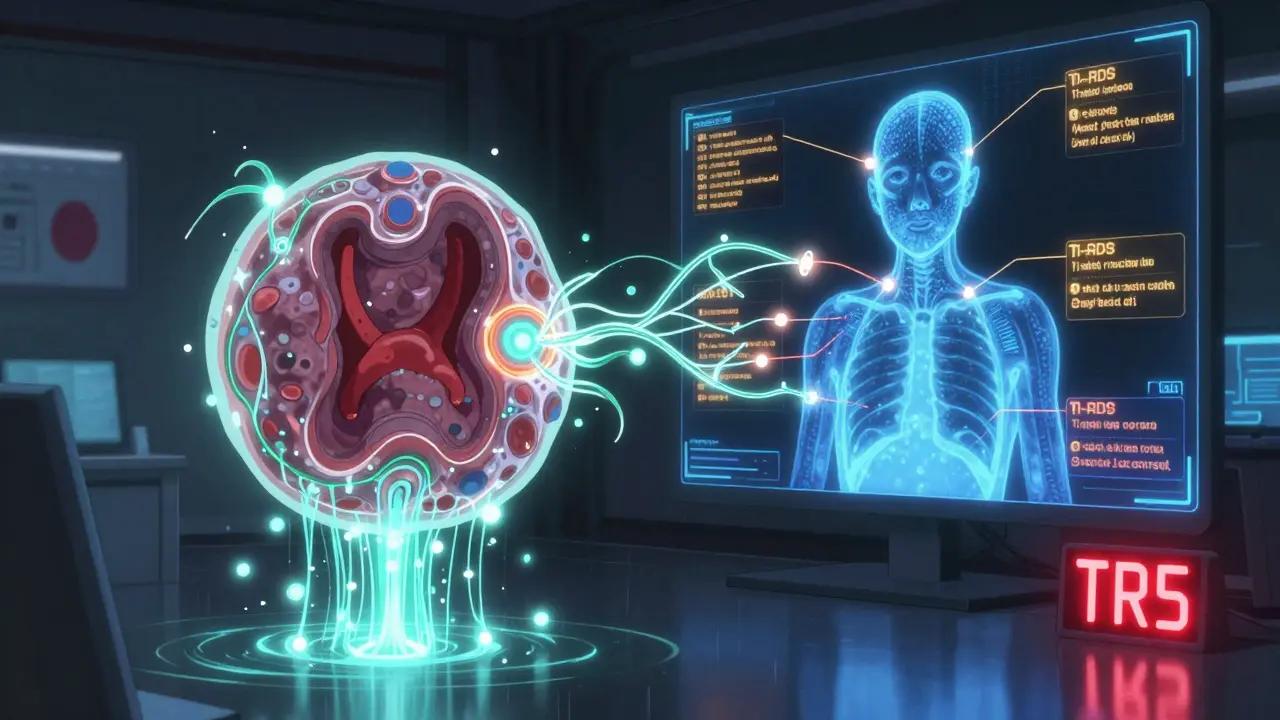
These five features are the foundation of TI-RADS, the system doctors use to score nodule risk. Each one gets 0 to 3 points. Add them up, and you get a risk level: TR1 (almost harmless), TR2 (low risk), TR3 (moderate), TR4 (suspicious), or TR5 (high risk).
How TI-RADS Works in Practice
Think of TI-RADS like a traffic light for your thyroid. TR1 is green-you’re looking at less than a 0.5% chance of cancer. TR2 is yellow-about 1.5% risk. TR3 is still mostly safe, with under 5% chance. But when you hit TR4, the risk jumps to over 9%. TR5? That’s 35% or higher. That’s not a guess. It’s based on data from tens of thousands of patients.
Here’s what that looks like in real life:
- A 1.2 cm solid nodule with microcalcifications and irregular borders? That’s TR5. Biopsy is needed.
- A 1.5 cm mostly cystic nodule with smooth edges and no calcifications? That’s TR1. No action needed.
- A 0.7 cm nodule with mild hypoechoic appearance and no other red flags? TR2. Monitor in 12-24 months.
Size matters-but not the way you think. A 2.5 cm nodule with no suspicious features is less concerning than a 6 mm nodule with microcalcifications. That’s why doctors don’t just measure size. They measure features.
Why Ultrasound Beats Other Tests
CT and MRI scans can find thyroid nodules too-but they’re like using a sledgehammer to crack a nut. They show you that something’s there, but not whether it’s dangerous. They also expose you to radiation and cost 3-5 times more.
Nuclear scans (like radioactive iodine uptake tests) can tell you if a nodule is “hot” (overactive) or “cold” (underactive). Hot nodules are almost never cancerous. Cold ones have about a 15% risk. But here’s the catch: nuclear scans can’t see microcalcifications, irregular borders, or shape. They can’t guide a biopsy. And they still use radiation.
Ultrasound does all of that. It’s the only test that can see the fine details that predict cancer. It’s also the only test that can guide the needle during a biopsy-cutting the chance of a bad sample from 25% down to under 5%.
When You Need a Biopsy
Not every nodule needs a biopsy. The rules are clear:
- Under 5 mm? No biopsy. Even if it looks suspicious. Too small to matter.
- 1 cm or larger with TR4 or TR5 features? Biopsy now.
- 1 cm or larger with TR3 features? Biopsy if it’s over 2.5 cm. Otherwise, watch it.
- Indeterminate biopsy result? Molecular testing can help. But you still need follow-up ultrasounds.
Doctors don’t biopsy every nodule because most are harmless. In fact, up to 70% of adults have at least one thyroid nodule-fewer than 1 in 10 turn out to be cancer. Biopsies are invasive. They’re expensive. And they cause anxiety. So we only do them when the ultrasound says the risk is high enough to justify it.
What Ultrasound Can’t Do
Ultrasound is powerful-but it’s not magic. It can’t tell you for sure if a nodule is cancerous. Only a biopsy can. Some nodules look suspicious but turn out benign. Others look quiet but hide cancer. That’s why experts say: ultrasound assesses risk. Biopsy confirms it.
It also struggles with nodules that go deep behind the breastbone (substernal goiters). In those cases, CT or MRI might be needed. And if the nodule is near the windpipe or voice box, your doctor might order an endoscopic ultrasound-this is rare, but it happens.
Another big issue? Operator skill. Not every tech or radiologist reads thyroid ultrasounds the same way. Studies show that even experienced doctors disagree on margin and echogenicity about 30-40% of the time. That’s why accreditation matters. Facilities with AIUM or ACR accreditation have better consistency. Ask your provider if they’re accredited.
The Rise of AI in Ultrasound
Artificial intelligence is changing thyroid ultrasound. A 2023 study in Nature Scientific Reports tested a new AI model that analyzed nodule shape, texture, and vascularity. It got 94.2% accuracy-better than human radiologists using traditional methods (87.6%).
How? It spots patterns humans miss. Like how the ratio of height to width affects cancer risk. Or how subtle changes in blood flow inside the nodule correlate with malignancy. The AI doesn’t replace the radiologist. It helps. It flags borderline cases. It reduces variability. And it’s already being tested in hospitals.
The American College of Radiology is updating TI-RADS in 2024 to include AI-enhanced features. The goal? Cut unnecessary biopsies by 30% without missing cancers.
What Happens After the Ultrasound
If your nodule is low risk (TR1-TR2), you’ll likely get a repeat ultrasound in 1-2 years. No surgery. No meds. Just monitoring.
If it’s TR4 or TR5, you’ll get a biopsy. If the biopsy says “benign,” you still need follow-up ultrasounds. About 5-10% of “benign” nodules grow or change over time.
If the biopsy is “indeterminate,” molecular testing can help. Tests like Afirma or ThyroSeq look at gene patterns. They can rule out cancer in many cases-saving people from unnecessary surgery.
And here’s something most people don’t know: if you have a tiny papillary cancer under 1 cm and no signs of spread, many doctors now recommend active surveillance instead of surgery. Studies show 99%+ survival rate after 10 years of watching it closely. Surgery isn’t always the answer.
What to Ask Your Doctor
Don’t just accept a diagnosis. Ask:
- What’s the TI-RADS category of my nodule?
- What specific features made it that score?
- Do you see any lymph nodes that look abnormal?
- Is your facility accredited by AIUM or ACR?
- Will you use ultrasound to guide the biopsy if needed?
- What happens if I choose to wait instead of biopsy?
These aren’t just questions. They’re your rights as a patient. The right answer isn’t always action. Sometimes, it’s patience.
What’s Next for Thyroid Ultrasound
Thyroid cancer rates have tripled since the 1970s-but most of that increase is due to better detection, not more disease. Ultrasound found them all.
The future? Personalized risk scores. Combining ultrasound features with blood markers, genetic profiles, and AI predictions. Imagine a single number-your personal cancer risk-that tells you whether to watch, biopsy, or act. That’s coming by 2030.
For now, ultrasound remains the gold standard. It’s safe, cheap, accurate, and non-invasive. It doesn’t need to be replaced. It just needs to be done right.
If you’ve been told you have a thyroid nodule, don’t panic. Do ask for the ultrasound report. Understand the TI-RADS score. Know what features matter. And remember: most nodules aren’t cancer. But knowing the difference could save your life.


Dave Old-Wolf
January 8, 2026 AT 06:36