You’ve been taking the same prescription medication for years. You know the color, the shape, and even the specific imprint on the pill. Then, one day, your pharmacist hands you a box that looks slightly different. It’s cheaper, but it doesn’t have the familiar brand name. Is it a fake? A mistake? Or is it an authorized generic? If you’re scratching your head, you’re not alone. This confusing corner of the pharmaceutical world often leaves patients wondering if they are getting the same medicine they paid premium prices for.
The short answer is yes, it is the exact same medicine. But to understand why it exists, how it differs from the generic you usually buy, and whether you should be concerned, we need to peel back the layers of how drug companies operate when their patents expire. This isn't just about saving money; it's a strategic move by big pharma that impacts what ends up in your pill bottle.
Defining the Authorized Generic
To get this straight, let’s look at the definition provided by the U.S. Food & Drug Administration (FDA). An authorized generic is defined as an "approved brand name drug that is marketed without the brand name on its label." Other than the missing logo, it is the identical drug product as the branded version. Think of it like buying a designer shirt that has had the tag removed. The fabric, the stitching, and the cut are exactly the same; only the branding is gone.
Authorized Generics are brand-name drugs sold without the brand name label, manufactured by the original brand company or its licensee. They share the New Drug Application (NDA) with the brand-name drug, meaning they do not require separate bioequivalence testing like traditional generics.
This concept first appeared in the U.S. market in the 1990s but became much more common in the early 2000s. Unlike traditional generic drugs, which are made by completely different companies after a patent expires, authorized generics come directly from the source-the original brand manufacturer. They are produced under the original brand-name drug’s New Drug Application (NDA). This means every aspect, from active ingredients to inactive fillers, dosage form, strength, and quality standards, matches the brand-name product perfectly.
How They Differ From Traditional Generics
This is where most people get confused. Aren’t all generics the same? Not quite. While both authorized and traditional generics aim to provide lower-cost alternatives, their origins and regulatory paths are worlds apart.
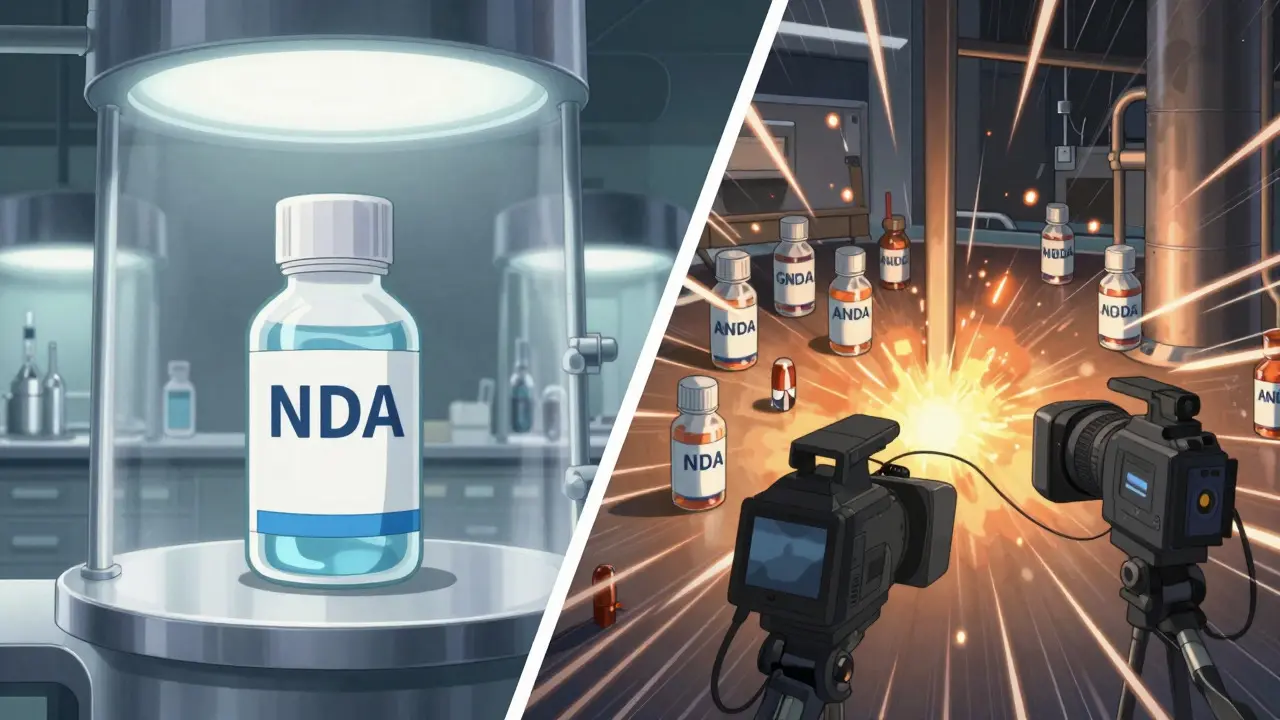
Traditional generic drugs must go through a rigorous process called the Abbreviated New Drug Application (ANDA). The manufacturer has to prove to the FDA that their version is bioequivalent to the brand-name drug. This means it works in the body the same way. However, traditional generics can-and often do-contain different inactive ingredients. These are the binders, dyes, and fillers that give the pill its shape and color. For some sensitive patients, these differences matter.
Authorized generics skip the ANDA process entirely. Because they are made by the same company that holds the NDA for the brand-name drug, the FDA considers them identical. No new approval is needed; the brand manufacturer simply notifies the FDA that they are marketing the drug without the brand name. Consequently, authorized generics are not listed in the FDA’s Orange Book, which tracks approved therapeutic equivalents for traditional generics.
| Feature | Authorized Generic | Traditional Generic |
|---|---|---|
| Manufacturer | Original Brand Company (or licensee) | Third-Party Company |
| Active Ingredient | Identical to Brand | Identical to Brand |
| Inactive Ingredients | Identical to Brand | May Differ from Brand |
| Approval Process | Notification to FDA (uses existing NDA) | ANDA (Bioequivalence required) |
| Listed in Orange Book? | No | Yes |
| Pricing | Lower than Brand, Higher than Traditional | Lowest Price |
The Strategic Game Behind the Label
Why would a big pharmaceutical company sell its own expensive drug at a discount? It sounds counterintuitive, right? If you make $500 selling a brand-name pill, why sell it for $300? The answer lies in market strategy and protecting revenue streams during the inevitable loss of patent exclusivity.
When a drug’s patent expires, competitors rush in with traditional generics. Historically, this caused brand-name sales to plummet almost overnight. Authorized generics allow the brand manufacturer to stay in the game. By launching their own "generic," they capture a portion of the price-sensitive market that would otherwise switch entirely to third-party competitors.
A comprehensive study published in Health Affairs in December 2022 analyzed 854 authorized generic launches between 2010 and 2019. The data revealed a clear pattern: launch activity peaked in 2014. More importantly, the timing was calculated. In markets where traditional generic competition already existed, 75% of authorized generics launched after the generic competition had started. This suggests a defensive posture. Brand manufacturers were using authorized generics to maintain market presence and relationships with pharmacy benefit managers (PBMs) even as traditional generics entered the scene.
Furthermore, when traditional generics were eligible for the 180-day marketing exclusivity period-a reward for the first generic challenger to file an ANDA-approximately 70% of authorized generics launched either before or during this window. This allowed the brand company to compete directly with the sole exclusive generic maker, potentially diluting that competitor’s advantage.
Impact on Pricing and Patient Costs
For the patient, the immediate question is always about cost. Do authorized generics save money? Yes, but perhaps not as much as you might hope compared to traditional generics.
Pricing for authorized generics typically sits in the middle ground. They are usually priced 15% to 25% lower than the brand-name version. Some sources suggest savings can reach up to 30% depending on the specific drug and insurance coverage. However, they are often more expensive than traditional generics once multiple generic manufacturers enter the market. Traditional generics drive prices down through intense competition among many suppliers. Authorized generics face less direct competition because there is usually only one source: the original brand maker.
This creates a complex landscape for payers and patients. Insurance plans may prefer authorized generics over brand names due to the lower cost, but they might still prefer traditional generics over authorized ones if available. For patients who cannot tolerate the inactive ingredients in traditional generics, authorized generics offer a crucial alternative. Since they contain the exact same inactive components as the brand-name drug, patients who switched to a traditional generic and experienced side effects or efficacy issues can return to the "original" formulation via the authorized generic route, often at a reduced copay.
Real-World Examples
To make this concrete, let’s look at some real-world examples where authorized generics have played a significant role. Understanding these cases helps illustrate how common this practice has become.
- Colcrys (colchicine): The brand-name drug Colcrys was used to treat gout flares. Prasco Laboratories launched an authorized generic version of colchicine. This allowed patients access to the exact same formulation without the brand-name price tag.
- Concerta (methylphenidate ER): Watson Pharmaceuticals (now part of Actavis/Viatris) launched an authorized generic for Concerta, a popular ADHD medication. This move helped them retain market share as other generic versions began to appear.
- Celebrex (celecoxib): Greenstone Pharmaceuticals introduced an authorized generic for Celebrex, a nonsteroidal anti-inflammatory drug (NSAID). This provided a lower-cost option for arthritis sufferers while maintaining the brand’s manufacturing standards.
- Unithroid (levothyroxine): Jerome Stevens Pharmaceuticals offered an authorized generic for Unithroid, a thyroid hormone replacement. Given the sensitivity of thyroid patients to formulation changes, this allowed those loyal to the Unithroid formula to save money without switching to a different manufacturer’s generic.
These examples highlight a key point: authorized generics are not limited to obscure medications. They appear across major therapeutic categories, including cardiovascular, central nervous system, and endocrine treatments.

Navigating Confusion: What Patients and Pharmacists Should Know
Despite being therapeutically identical, authorized generics can cause confusion. Imagine receiving a pill that looks different from your usual brand-name medication but is dispensed as a "generic." You might wonder if your pharmacist made a mistake or if the drug store is trying to cut corners.
Pharmacists play a critical role here. They are often the first line of defense against patient anxiety. When dispensing an authorized generic, pharmacists should counsel patients on the fact that the medication is chemically identical to the brand-name product they were previously taking. The change in appearance-different color, shape, or imprint-is purely for labeling purposes to distinguish it from the brand-name version on the shelf.
One practical challenge is identification. Since authorized generics are not listed in the FDA’s Orange Book, they don’t show up in standard generic equivalence databases. Healthcare providers need to rely on the FDA’s official "List of Authorized Generic Drugs," which is updated periodically. As of recent updates, this list serves as the primary reference for identifying which drugs have authorized generic versions available.
Patients should also be aware that not all brand manufacturers produce authorized generics themselves. Sometimes, the brand company licenses the formulation to another manufacturer who then produces and markets the authorized generic. Regardless of who physically makes the pill, the formulation remains identical to the brand-name product.
The Future of Authorized Generics
Looking ahead, authorized generics are likely to remain a significant factor in the pharmaceutical market. The strategic advantages they offer to brand manufacturers-maintaining market share, protecting revenue, and offering a "safe" generic alternative for sensitive patients-are too valuable to abandon. However, their long-term viability depends on regulatory oversight.
Some experts argue that authorized generics undermine the competitive dynamics intended by the Hatch-Waxman Act, which designed the generic drug system to promote price competition. If brand manufacturers can effectively block or dilute traditional generic competition by flooding the market with their own authorized versions, does true competition occur? Researchers continue to study the effect of authorized generics on overall drug prices and access. Current evidence suggests they provide a modest price reduction compared to brands but may delay the deeper discounts associated with multiple traditional generic entrants.
For now, the FDA maintains its position that authorized generics are "exactly the same as the brand name drug." As long as this regulatory stance holds, patients will continue to encounter these products. The key is awareness. Knowing that an authorized generic is a legitimate, high-quality option backed by the original manufacturer can help reduce uncertainty and ensure patients receive the best value for their health needs.
Is an authorized generic safer than a traditional generic?
Both authorized and traditional generics are considered safe and effective by the FDA. However, authorized generics are chemically identical to the brand-name drug, including inactive ingredients. For patients who have experienced sensitivities or side effects from the fillers or dyes in traditional generics, an authorized generic may be a better tolerated option because it matches the original brand formulation exactly.
Can my doctor prescribe an authorized generic specifically?
Doctors typically prescribe by generic name. Whether you receive an authorized generic or a traditional generic depends on your pharmacy’s inventory and your insurance plan’s preferred drug list. If you need the specific formulation of the brand-name drug (which an authorized generic provides), you can ask your pharmacist if an authorized generic is available or request the brand-name drug, though the latter may cost more.
Why aren't authorized generics listed in the Orange Book?
The FDA’s Orange Book lists drugs that have received approval through the Abbreviated New Drug Application (ANDA) process, proving therapeutic equivalence to a reference listed drug. Authorized generics do not undergo the ANDA process because they are marketed under the original brand-name drug’s New Drug Application (NDA). Therefore, they are not included in the Orange Book but are tracked separately on the FDA’s List of Authorized Generic Drugs.
Do authorized generics work differently in the body?
No. Because an authorized generic is the exact same product as the brand-name drug, it works identically in the body. It has the same active ingredient, dosage, strength, and route of administration. There is no difference in bioavailability or clinical effect compared to the brand-name version.
Are authorized generics always cheaper than brand-name drugs?
Yes, authorized generics are typically priced lower than their brand-name counterparts, often by 15% to 30%. However, they may be more expensive than traditional generics, especially when multiple generic manufacturers are competing in the market. Your final out-of-pocket cost will depend on your specific insurance coverage and formulary tier placement.