
When your doctor says you need an ECG or a stress test, it’s not because they’re being overly cautious-it’s because they’re looking for answers your body can’t give you while you’re sitting still. These tests aren’t scary, but they’re powerful. They can catch problems your heart hides during rest, like blocked arteries or irregular rhythms that only show up when you’re pushing yourself. And if you’ve ever felt short of breath climbing stairs or had chest tightness that went away after resting, these tests might be the key to understanding why.
What an ECG Actually Measures
An ECG, or electrocardiogram, is a quick, painless snapshot of your heart’s electrical activity. It doesn’t measure blood flow or how hard your heart is pumping-it tracks the tiny electrical signals that make your heart beat. Think of it like listening to the rhythm of a clock. If the ticks are off, it might mean something’s wrong.During the test, ten small sticky pads (electrodes) are placed on your chest, arms, and legs. These don’t shock you-they just record. The whole thing takes less than five minutes. You lie still, breathe normally, and that’s it. The machine draws a graph of waves-P waves, QRS complexes, T waves-that doctors learn to read like a language.
A normal ECG shows a steady pattern: a small bump (P wave), a sharp spike (QRS complex), then a smaller curve (T wave). If the spike is too wide, it could mean the heart’s electrical signal is delayed. If the T wave is flat or inverted, it might mean the heart muscle isn’t getting enough oxygen. An ECG can spot a past heart attack, an abnormal rhythm like atrial fibrillation, or even signs of an enlarged heart.
But here’s the catch: a normal ECG doesn’t mean your heart is perfect. Many people with blocked arteries have perfectly normal resting ECGs. That’s why doctors sometimes need to push the heart harder-to see what happens under stress.
Why Stress Tests Are Different
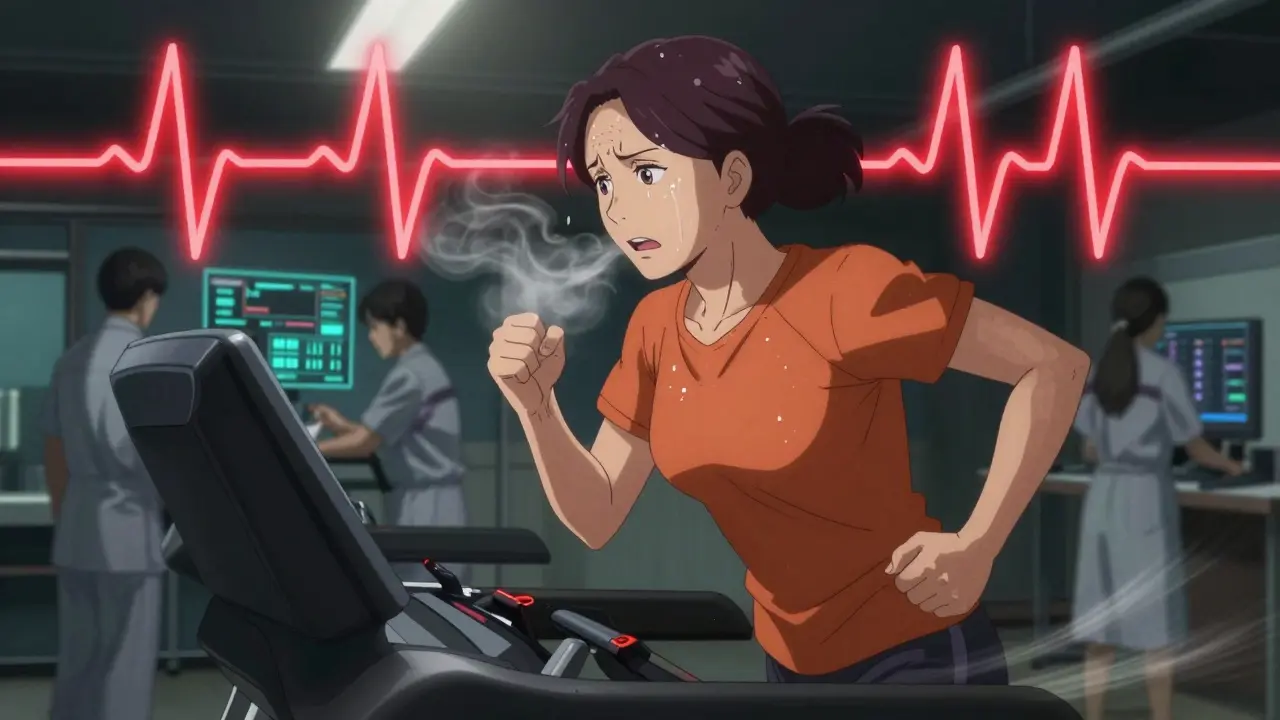
A stress test is like a workout for your heart, but with monitors watching every move. The goal? To see how your heart handles being pushed. When you’re at rest, your heart doesn’t need much oxygen. But when you walk fast, climb stairs, or run, your heart works harder-and so do your arteries. If one is narrowed by plaque, it can’t deliver enough blood, and your heart sends out warning signs.The most common type is the exercise stress test. You walk on a treadmill, starting slow and getting harder every three minutes. The speed and incline increase according to the Bruce protocol: 1.7 mph at 10% incline, then faster and steeper. You keep going until you’re tired, your heart rate hits 85% of your maximum (calculated as 220 minus your age), or you get symptoms like chest pain, dizziness, or shortness of breath.
While you’re on the treadmill, your heart rate, blood pressure, and ECG are tracked continuously. If your ECG shows a dip in the ST segment, that’s a red flag-it often means the heart muscle is starved for oxygen. If you can only walk for 4 minutes before stopping, that’s worse than walking for 12. Each extra minute you can go lowers your risk of a future heart event by about 12%.
What If You Can’t Exercise?
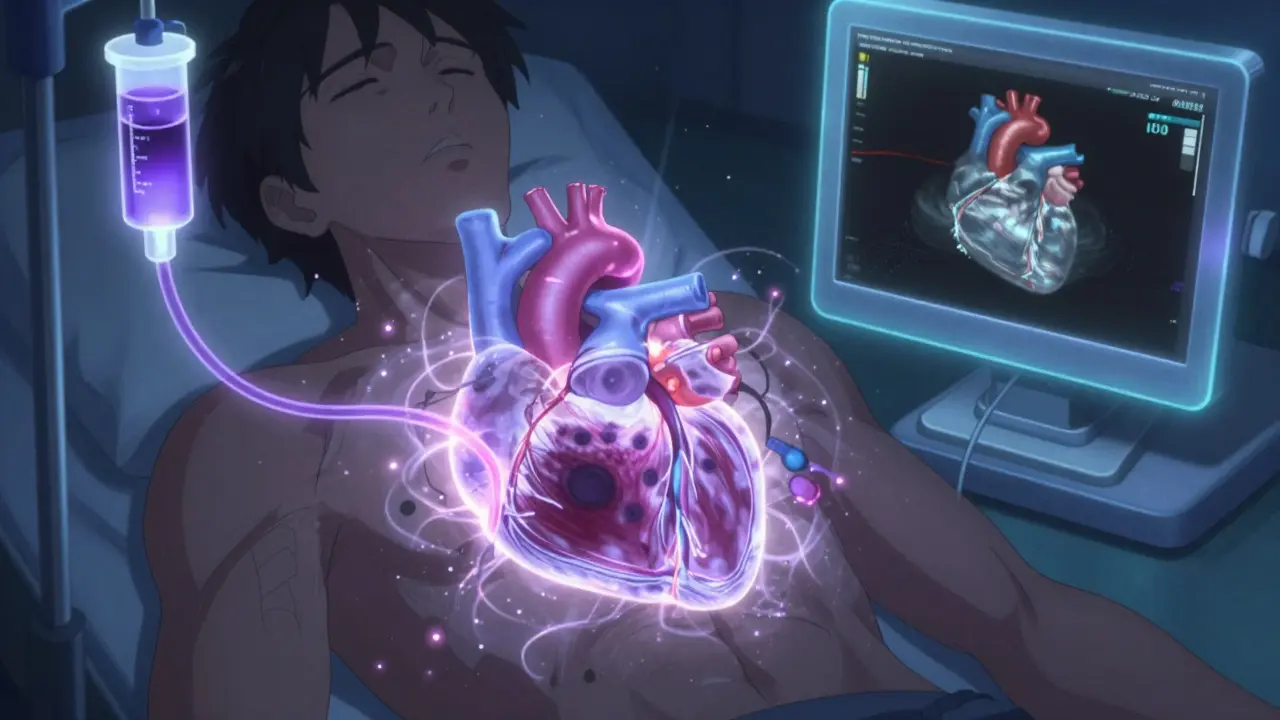
Not everyone can walk on a treadmill. Maybe you have bad knees, severe asthma, or just can’t catch your breath. That’s where chemical stress tests come in.Instead of walking, you get a drug through an IV-adenosine, dipyridamole, or dobutamine. These drugs mimic the effects of exercise by speeding up your heart or dilating your blood vessels. You might feel hot, flushed, short of breath, or even get chest pressure. It sounds scary, but it’s normal. The effects last less than a minute. A nurse is right there, and the test stops if anything looks risky.
Chemical tests take longer-30 to 60 minutes-and they’re not perfect. Some people get headaches or nausea. But for those who can’t move, they’re the only way to get the same info as a treadmill test.
Imaging Makes It Clearer
Sometimes, just looking at the ECG isn’t enough. That’s where imaging steps in. Stress echocardiography uses ultrasound to take pictures of your heart before and after stress. You can actually see if part of your heart wall isn’t moving right-meaning it’s not getting enough blood. This test has higher accuracy than plain ECG stress tests, especially for women.Nuclear stress tests go a step further. You get a tiny amount of radioactive tracer injected, then a special camera takes pictures of your heart. Areas with poor blood flow show up as dark spots. These tests are more sensitive-they catch more blockages-but they expose you to radiation, about the same as 3-4 years of natural background exposure. That’s why they’re usually saved for higher-risk cases.
Stress echocardiography, on the other hand, uses no radiation. It’s becoming the go-to for middle-aged women with chest pain but no clear blockages on angiograms. New techniques like speckle-tracking strain analysis can detect subtle changes in heart muscle movement, catching microvascular disease that older tests missed entirely.
Who Gets These Tests-and Who Doesn’t
These tests aren’t for everyone. If you’re young, healthy, and have no symptoms, you don’t need one. If you’ve just had a heart attack, you’re too unstable. Same if you have a dangerous arrhythmia or uncontrolled heart failure.Doctors use them mostly for people with intermediate risk-people who have some symptoms (like chest discomfort with activity), maybe a family history, and a few risk factors like high blood pressure or smoking. For those folks, the test helps decide: Is this just anxiety, or is there a real problem?
Women, especially premenopausal women, are more likely to get false-negative results on ECG stress tests. Their heart disease often affects smaller vessels, not the big arteries. That’s why stress echocardiography is now recommended for them-it’s better at spotting these hidden issues.
And while CT scans of the heart are getting popular, they’re not always better. A major study called PROMISE found that over three years, patients who got CT scans spent about the same amount on healthcare as those who got stress tests. So if you’re not sure which test you need, ask: What’s the goal? To see anatomy? Or to see function?
What to Expect Before and After
You don’t need to fast, but you should avoid caffeine for 24 hours before the test. Coffee, tea, chocolate, energy drinks-even some painkillers-can interfere with the drugs used in chemical stress tests. Wear loose clothes and walking shoes. No jewelry, no lotions on your chest.After the test, you can usually go home right away. If you had a chemical stress test, you might feel a little shaky or tired for a few minutes. No one needs to drive you home unless you had sedation-which is rare.
Results? Many clinics give you a quick readout before you leave. A full report from a cardiologist might take a day or two. If something’s off, you’ll hear from them fast. If it’s normal, you’ll get a letter. But don’t assume normal means perfect. If your symptoms keep coming back, go back. Tests aren’t magic-they’re tools.
What the Numbers Don’t Tell You
The stats are impressive: ECG stress tests catch about 68% of coronary artery disease cases. Stress echocardiography catches more-up to 88%. Nuclear tests catch even more, but with radiation. But numbers don’t tell the whole story.One patient, a 56-year-old woman with mild chest tightness, had a normal resting ECG. Her stress test showed a clear drop in the ST segment at peak effort. She had a blockage in one artery. She got a stent. Now she walks three miles a day.
Another man, 68, with no symptoms, had a stress test because his doctor thought he was “at risk.” His test was normal. He was relieved-until six months later, he had a heart attack. The blockage was in a small vessel, invisible to the test.
That’s why tests are part of the picture, not the whole thing. Your symptoms, your history, your lifestyle-they matter just as much.
The Future of Heart Testing
AI is starting to help read stress tests. Algorithms trained on thousands of ECGs can spot patterns humans miss. One study showed AI improved accuracy by up to 22%. Portable devices like the Cardiac Dynamics StressPal are now approved for use in doctor’s offices, pharmacies, even urgent care centers. In five years, you might get a stress test during your annual checkup-not because you’re sick, but because it’s part of prevention.But the core hasn’t changed. The ECG is still the foundation. Stress testing is still the way we see how your heart holds up under pressure. And for now, that’s the best way we have to catch heart disease before it catches you.
Is an ECG the same as a stress test?
No. An ECG records your heart’s electrical activity while you’re at rest. A stress test records the same thing-but while you’re exercising or under chemical stress. The stress test shows how your heart reacts when it’s working harder, which can reveal problems a resting ECG misses.
Can a stress test show a blocked artery?
Yes, but not directly. A stress test doesn’t show the blockage itself like an angiogram does. Instead, it shows signs that a blockage is affecting blood flow-like changes in your ECG, abnormal heart wall movement on ultrasound, or areas of poor blood flow on a nuclear scan. These signs strongly suggest a blockage is present.
Are stress tests safe?
Yes, for most people. Stress tests are done under medical supervision, and the team is ready to stop if anything goes wrong. Serious complications are rare-less than 1 in 1,000 tests. The biggest risk is for people with unstable heart conditions, which is why doctors screen you first. If you’re healthy enough to walk up stairs, you’re probably healthy enough for a stress test.
Do I need to prepare for a stress test?
Yes. Avoid caffeine for 24 hours before the test-it can interfere with the drugs used in chemical stress tests. Don’t eat a heavy meal two hours before. Wear comfortable clothes and shoes you can walk in. If you’re on heart medications, ask your doctor if you should skip them that day-some need to be held for accurate results.
What if my stress test is normal but I still have symptoms?
Don’t ignore it. A normal stress test doesn’t rule out all heart problems. Some conditions, like microvascular disease or spasms in small arteries, don’t show up on standard tests. If your symptoms persist-especially chest pain, shortness of breath, or fatigue with activity-ask about further testing like stress echocardiography, coronary CT angiography, or blood tests for inflammation markers.
How accurate are stress tests?
It depends on the type. A standard exercise ECG stress test is about 68% sensitive and 77% specific for coronary artery disease. Stress echocardiography improves that to 82-88% specificity. Nuclear stress tests are more sensitive (around 85%) but involve radiation. New AI-assisted tools are pushing accuracy even higher. No test is perfect, but together with your symptoms and risk factors, they give a strong picture.


jefferson fernandes
January 14, 2026 AT 05:29